The people of Ecuador are rising up to refound their country as a pluri-national homeland for all. This inspiring movement, with Ecuador's indigenous peoples at its heart, is part of the revolution spreading across the Americas, laying the groundwork for a new, fairer, world. Ecuador Rising aims to bring news and analysis of events unfolding in Ecuador to english speakers.

Friday, March 06, 2009

Ecuador vows to seize Perenco oil in debt dispute

IHT, 4 March 2009

QUITO, Ecuador: Ecuador plans to seize 70 percent of oil produced daily by Perenco SA, nearly quadrupling its cut until it collects enough to cover the company's contested back taxes, a top energy official said Wednesday.

Energy Minister Derlis Palacios said the government will seize about 19,000 barrels of locally produced crude from Paris-based Perenco a day, but won't touch other company assets. At current crude prices of about $36 a barrel for Ecuadorean crude, it would take the country about 494 days to recover its debt.

Under Perenco's current contract, Ecuador has received 18 percent of its daily output.

President Rafael Correa in February ordered Perenco to pay $338 million in unpaid taxes, accumulated since a 2007 decree raised the levy on windfall oil income to 99 percent. Madrid-based oil company Repsol YPF last week agreed to pay $447 million in back taxes and interest by 2014.

Cash-strapped Ecuador relies on oil exports for 40 percent of its federal budget. It has renegotiated energy deals with Repsol, China's Andes Petroleum and Brazil's state-run Petrobras SA to boost its share in oil profits by trying to switch to fee-for-service rather than per- barrel contracts. It also paid U.S.-financed City Oriente $69 million to exit its contract early.

Perenco, which produces an average of 27,500 barrels of crude per day, or 5.5 percent of Ecuador's daily output, is the last company not to renegotiate its contract.

Palacios on Wednesday blamed Perenco's U.S.-based minority partner Burlington Resources for stalling negotiations on the outstanding taxes. Burlington filed a suit before a World Bank arbitration body in June 2008 to avoid the payments. A decision has not yet been issued.

Calls for comment were not answered Wednesday at Perenco's Quito office or at Houston-based ConocoPhillips, which bought Burlington in 2006.

Falling oil prices have slashed government revenue and now have Ecuador, South America's fifth-largest oil producer, forecasting a $3.5 billion trade deficit for 2009.


Ecuador Congress Slams US Meddling

Quito, Mar 4 (Prensa Latina) A condemnation by the Legislative Commission of the United States for interfering in Ecuador's internal affairs joins Wednesday the rejection previously stated by the national government.

With 56 votes for, nine blank ballots and two abstentions, the parliamentary body supported the executive's sovereign attitude that called for Washington some days ago to respect international relations and refuted any form of interference in internal affairs by another nation.

The proposal, presented by Legislative Commission First Vice Chairman Cesar Rodriguez and adopted on Tuesday, also demands "respect to the peoples' independence and self-determination."

The congressional plenary session also refuted statements by Central Intelligence Agency (CIA) director Leon Panetta, who predicted instability process in this country, Venezuela and Argentina, due to the effects of the international financial crisis.

Panetta's statements are an unacceptable interference in Ecuador's internal affairs and threaten respect in the bilateral relations among the sovereign States, the text stresses.

Shortly before approving that accord, assembly members from several political forces stated that there can be no foreign interference in internal issues and spoke out for the need of creating a precedent so that no state meddles in exclusive aspects of other national capacities.

Ecuador Defends National Sovereignty

Quito, Mar 4 (Prensa Latina) Ecuador"s Minister of Foreign Affairs Fander Falconi defended on Wednesday the concept of national sovereignty and rejected the extraterritorial policy promoted by US President George W. Bush"s administration.

It is not about Colombia President Alvaro Uribe refusing his Defense Minister Juan Manuel Santos´ statements justifying the aggression against Ecuador a year ago, but condemning such practice of interfering in another nation"s affairs, Falconi said.

"There is a concept that we have to eradicate, that of extraterritoriality, the possibility of interfering in third countries. That was part of the Bush"s doctrine," when a third nation was attacked, because it was not in line with some statements about international politics, he said.

The minister said that "this is extremely serious and deserves to be categorically rejected," because it can not be tolerated, and there are no moral or material arguments for a country to invade another.

I think this is part of a dark story in Latin America that should be erased, he asserted, and recalled that one of the lessons taught by the Colombia attack to this country in 2008 is that sovereignty can not be violated.

Referring to the Colombian media, which have announced the possible presence in Ecuador of guerrillas from the neighboring country, he said information was requested through the Organization of American States (OAS), in charge of mediate in the Quito-Bogota crisis.

They sent a note to the OAS, saying that it would be really appreciated that the General Secretary"s Office expresses to the Colombian government the need to provide Ecuador with accurate information about the exact location of the mentioned Revolutionary Armed Forces of Colombia (FARC) top commands, he stated.

The Ecuadorian government is concerned about the media assertions, saying that the members of the FARC General Staff would be sheltered in this country, according to an intelligence report from Colombia, he said.

This is not the way to provide information, through a radio station, said the foreign minister, highlighting the presence of around 13,000 men, deployed at the northern border to guarantee defense and repel the entry of any armed group into the country.

Ecuador Indians Want Oil-Spill Emergency Declared

LAHT.com
QUITO – Representatives of the Confederation of Indigenous Nationalities of Ecuador, or Conaie, and regional organizations warned Tuesday about the effects of the oil spill in an area of the Amazon and asked that a state of emergency be declared in the affected communities.

Conaie leader Marlon Santi told a press conference that some 47 indigenous communities were hit by the Feb. 25 spill of some 14,000 barrels of crude when an earthquake cracked open an OCP pipeline.

The spill, which Santi called “worrying,” took place near the Santa Rosa River, and contaminated its waters and those of the Napo and Coca rivers.

The Indians asked the government for “urgent help” to diminish “the ecological, social and health damages” since, according to Santi, communities in the area are in “a desperate situation – besides life itself, the most important resources are water and crops.”

He said there were “nine people in a bad state of health” and complained that “there’s no serious social assistance.”

According to Blanca Grefa, head of an Indian organization in Orellana province, also polluted by the oil spill, the area is “super contaminated.” She said that besides “neighbors who were affected,” the fish and birds are also endangered.

The indigenous leader said that the communities are concerned because they have nowhere to get water and said that it’s only in cities of the sector where OCP has bothered to provide drinking water.

Grefa’s colleague Roberto Alvarado called on OCP to “sit down and negotiate with the communities to channel all aid to them,” and complained that the government “has not bothered” about the spill, whose consequences “could last two years.”

In that sense, Conaie’s Santi referred to the words of the new constitution which say that “in case of environmental damage, Ecuador will act immediately and will subsidize ways to protect health and ecosystems.”

“OCP is doing the clean-up, but the spill is big and the impact is serious. There’s no contingency planning or concern on the government’s part to force the OCP company to provide health and water services,” he said.

For its part, OCP announced in a communique that Tuesday the transport of crude will be renewed through the oil pipeline and that the clean-up operation will continue in the Santa Rosa district.

Oil is the main source of funding for the Ecuadorian government, since the revenues from its export contribute 35 percent to the budget. EFE

Ecuador wants to freeze assets of French oil company over unpaid taxes

QUITO, March 3 (Xinhua) -- The Ecuadorian government has asked a local tribunal to freeze the assets of the French oil company Perenco in a bid to recover unpaid taxes of 338 million U.S. dollars, authorities said Tuesday.

Perenco failed to pay the tax Monday as expected and will face legal action, Mining and Oil Minister Derlis Palacios told a local TV channel station.

"Perenco has goods, fields and oil. The judge will decide which measures are allowed by the law to cover those values," Palacios said.

Palacios said Monday that he met with Perenco executives but "unfortunately we did not reach concrete agreements and the company did not give a proposal to pay its multimillion debt."

President Rafael Correa in February ordered legal action to start against Perenco and Spain's Respol because neither had paid taxes on their extraordinary profits from oil exports from Ecuador.

Repsol last week agreed to pay 447 million dollars in unpaid taxes over a five-year period.

Under a 2007 decree, foreign companies are required to pay Ecuador 99 percent of the unexpected income earned from record oil prices.

Ecuador plans to invest $800 mln in local banks

QUITO, March 3 (Reuters) - Ecuador plans to invest around $800 million in its financial sector to jumpstart an economy reeling from low oil prices, Economic Policy Minister Diego Borja said on Tuesday.

Fernando Pozo, the head the private banks association, said after a meeting with Borja that the financial sector and government will together seek alternative credit lines from abroad.

"The amount is about $800 million this year," Borja said when asked how much the government planned to invest in the sector.

The government's investment could come from the country's foreign reserves and should enable banks to extend more credit to clients, Borja said.

The move will also help the system's liquidity, which he described as "stable."

Ecuador is pushing for banks to hand out more loans to the poor and middle class to boost an economy that has seen key exports like flowers and shrimp plummet due to the global crisis.

Canadian Mining Firm Financed Violence in Ecuador: Lawsuit

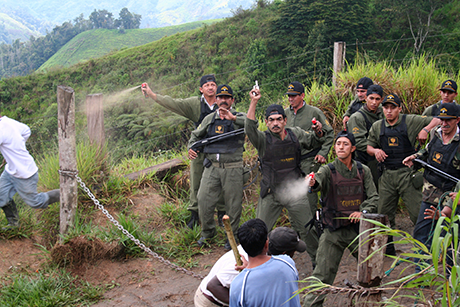
Ecuador, December of 2006: Armed security guards fire guns and tear gas as they confront villagers opposed to a Canadian-financed mine. Photo by Elizabeth Weydt.

TMX Group denies claim. Win could affect thousands of other projects by Canadian companies.

By Jennifer Moore
Published: March 3, 2009
, TheTyee.ca

"Financing being raised in Canada is travelling across borders to do harm," said lawyer Murray Klippenstein by phone from his office in Toronto. "We want to find out if our legal system can respond to this."

Klippenstein is perhaps best known for his representation of the estate and family of native activist Dudley George, who was shot and killed by police in Ipperwash Provincial Park in Ontario in 1995. This lawsuit revealed deep political involvement from the premier's office and resulted in a landmark public inquiry.

In another ambitious and possibly precedent-setting case, Klippenstein is representing three villagers from the valley of Intag in northwestern Ecuador who are suing Copper Mesa Mining Corporation (TSX:CUX) and the Toronto Stock Exchange. They allege that company directors and the TMX Group have not done enough to reduce the risk of harm being faced by farmers and community leaders in Intag who have faced violent threats and attacks for opposition to a large open-pit copper mine in their pristine cloud forests.

Still, they hope to go further. "What is happening in Intag is illustrative of a wider problem," a summary of the legal claim states, "the corporate and financial unaccountability of the Canadian mining industry." So while the case uses established legal principles, the plaintiffs hope it will lead to long-awaited legal reforms to help better control thousands of Canadian financed projects abroad.

Klippenstein, who said he "has learned to go miles on very little," acknowledges the "staggering financial mismatch" and says that companies have hundreds of millions of dollars to gain, so it won't surprise him if they spend tens of millions on the case. He also anticipates years of counterattacks, including motions and appeals on technicalities.

But he emphasized that the basics of the case are straightforward. "There's a simple fundamental legal point that you shouldn't harm somebody and that you shouldn't use your money to hire someone who you know is likely to do harm."

Conflict escalates

Marcia Ramírez is secretary of the Intag Community Development Committee. She lives near the end of the road in an isolated village in one of the most biodiverse places on earth. Her community of Chalguayaco Alto sits at the crossroads of two biodiversity hotspots, the Tumbes-Chocó-Magdalena and the Tropical Andes.

"It isn't fair," she told The Tyee, "that a foreign company can come here and contract people who attack us for defending our rights, for wanting to live in a healthy environment, for defending our land and our water." She added, "We'd like the stock exchange to listen to us and to understand that we've been very hurt by one of their companies."

Now 25 years old, the fight against large scale copper mining has marked daily life for the diplomatic and dedicated leader since she was about 12.

Broad-based opposition to large scale copper mining arose when a Japanese company was initially carrying out mineral exploration a short distance away. When the company released its Environmental Impact Assessment report for the proposed mine, the news that four communities would be displaced, as well as massive deforestation, local desertification, river contamination and harm to endangered species sparked vociferous opposition that persists.

Since Copper Mesa, who has a strategic alliance with the giant Rio Tinto, took over the project in 2004, new issues have emerged with apparent attempts to break the opposition. Now land trafficking, threats of violence, as well as relatively high-paying job offers have been driving a wedge between neighbours and families in these rural communities.

"But," commented Ramírez, "what most hurt is when they came... with armed men and sprayed us with gas."

In early December 2006, over 50 heavily armed security guards, mostly ex-soldiers, were hired to reach company concessions and set up camp. Local residents had been tipped off and gathered along the narrow dirt road that the company-hired trucks would have to pass. When they arrived, Ramírez and others tried to urge the armed men to turn around. But instead, the security agents sprayed tear gas into their faces from only a metre away and fired their weapons into the air, injuring one man, also a plaintiff in the case.

When the residents didn't back down, the guards finally retreated.

The incident was caught on film by a European student researching the controversy and is retold as part of the recent film Under Rich Earth by director Malcolm Rogge that debuted at the Toronto International Film Festival in September. It has also been denounced in a complaint to the Inter-American Human Rights Commission.

Prior warning

Canadian authorities were warned that such an incident could arise.

On March 8th, 2005, three months before Copper Mesa (then Ascendant Copper) was listed on the TSX, County Mayor Auki Tituaña wrote to the Finance and Audit Committee of the Toronto Stock Exchange: "We consider it to be appropriate and fair that before accepting open "trade" of Ascendant Copper Corporation's stocks in the Stock Market, you evaluate in depth the "new" company's merits..."

Included in his list of 14 concerns were lack of prior community consultation, lack of legally required municipal approval, violation of a municipal ordinance that declares the area an "Ecological County," as well as attempts to foster divisions as a "means to achieve company profits against the citizen's will and at a cost of the loss of unique biodiversity in our territory."

Then in May, Carlos Zorrilla, executive director of the Ecological Defense and Conservation of Intag (DECOIN), travelled to Ottawa to present a complaint to the Department of Foreign Affairs claiming that Copper Mesa had violated the Organization for Economic Cooperation and Development's (OECD) Guidelines for Multinational Enterprises. Mining Watch and Friends of the Earth Canada supported the claim.

"I'm here," he says in a press release, "because Canadians need to understand the real risk of violence that is emerging as a result of this company's activities." He added, "The Canadian government must take action to curb the excesses of Canadian mining companies operating and exploring overseas."

The complaint was withdrawn after eight months when it was apparent that the appropriate authorities would not apply the relevant procedures. The legal summary notes that "the TSX stock market listing of Copper Mesa has allowed the company to obtain over $25 million in capital funds -- some of which paid for the armed attackers" in December 2006.

Carolyn Quick, director of corporate communications for the TMX Group, told The Tyee her firm considers the case to be "entirely without merit" and that they will "vigorously defend this position." She would give no further comment about the letter from Mayor Tituaña nor the complaint made to DFAIT. No one from Copper Mesa was available to speak with The Tyee.

Globalization of legal accountability

Another challenge in holding companies to account in Canada, where the bulk of the world's mining companies are based, are complicated corporate structures that criss-cross continents.

"By dispersing their actions across borders and saying that 'Well, we didn't do that in Canada or Ecuador, that decision was made in the U.S.,' they can evade accountability. The courts can respond and say 'Take this case somewhere else,'" says Klippenstein.

Copper Mesa whose headquarters in Colorado, "has connections to some nine different legal jurisdictions, making it difficult to identify which jurisdiction is the proper one in which to hold the corporation accountable," says the legal summary of the case.

The former website of Copper Mesa (then Ascendant Copper) acknowledged that its corporate structure makes suing directors difficult: "All of the directors of Ascendant and substantially all of their assets and those of Ascendant are located outside of Canada. It may not be possible for purchasers of securities being qualified for distribution under this prospectus to effect service of process within Canada upon directors who reside outside of Canada..."

It is for this reason that the lawsuit focuses on decisions allegedly made in Ontario.

'Establish clear legal norms in Canada'

However, one possible advantage for rural residents of Intag preparing for a lengthy legal battle on tricky Canadian territory is that they are not alone in their concern.

Their broader goals for legal regulations of Canadian mining companies echo what the Standing Committee on Foreign Affairs and International Trade (SCFAIT) and the United Nations Committee on the Elimination of Racial Discrimination and other civil society groups have already been saying.

While Carlos Zorrilla was in Ottawa in 2005, the SCFAIT was writing its 14th report, which recommended that the government "Establish clear legal norms in Canada to ensure that Canadian companies and residents are held accountable when there is evidence of environmental and/or human rights violations associated with the activities of Canadian mining companies."

The government responded saying that it "will continue to examine the best practices of other states attempting to address the accountability of businesses for activities conducted abroad." But it has yet to implement mandatory rules.

Still Klippenstein is hopeful in the face of tough odds. "One has to trust in the promise of a certain amount of fairness and independence that the justice system can provide. It has been shown that powerful people can be brought to kneel this way before."

It took eight years of legal proceedings before a public inquiry was called in the Dudley George case. They never even made it to court, but a long list of recommendations was implemented.

Ramírez is also optimistic that they have a chance at justice through Canadian courts as part of their fight to leave Intag's cloud forests intact.

She points out the variety of sustainable development projects that they have been working on as alternatives to large scale mining, including community owned watersheds, a mixed mini-hydroelectric company, as well as agricultural and tourism initiatives. She urges Canadians to see the benefits: "We want future generations to have what we have."

Ecuador Warns Colombia against Aggression

Quito, Mar 2 (Prensa Latina) Ecuadorian President Rafael Correa warned on Monday of the consequences of a new Colombian military action in this territory, as he rejected remarks made by Colombian Defense Minister Juan Manuel Santos.

"Mr. Santos, do not mess with Ecuador, do not make this terrible mistake; anyway, if your view is to persecute and attack terrorists everywhere, I can give you several books for you to see where you must start persecuting terrorists and drug traffickers, that is at home," said Correa.

Speaking at a police ceremony in Quito, the Ecuadorian president refuted remarks made by the Colombian top official, who, according to Bogota-based El Tiempo daily, justified the bombing of northern Ecuador by Colombian militaries a year ago, resulting in the killing of guerrilla Raul Reyes.

"Poor Mr. Santos; he has not realized that there is no room for aspirants to emperors," said Correa, while adding that "if despite its public apology for the aggression, the Colombian government continues with doctrines announced by its Defense minister, they will found us ready."

The Colombian attack a year ago triggered international rejection and the breaking-off of bilateral links between Quito and Bogota.

"He (Santos) says that relations will be restored when Ecuador wants, and Ecuador will want when Colombia gives up this hindrance of the George W. Bush doctrine of expecting that when it comes to defending their interests, they can violate another country's territorial sovereignty," stressed Correa.

Ecuador Sets Electoral Campaign Budget

Quito, Mar 2 (Prensa Latina) The Ecuadorian National Electoral Copuncil (CNE) is setting on Monday campaign expenses for each of the candidates running in April 23 elections.

The electoral campaign begins next Tuesday, so candidate lists, posters and ballot papers will be ready as for Monday, CNE Chair Omar Simon said.

He said the exact and definitive amounts of campaign money for each candidate will be set on Monday.

The CNE approved Friday a resolution in relation to the method to be used to allocate the economic resources to the different candidacies.

We are speaking of a 41 million dollar budget, and 13 percent will be assigned to each list and in the case of regional and sectional candidacies, the amount to be allocated will be 30 percent, he explained.

Simon highlighted that there would be an additional fund of around $10 million, which will be devoted to debate programs or spaces that the CNE would hire for the candidates to be able to present their working plans, as established by the Constitution.

Once ths issue concludes, the CNE will be completely devoted to control the electoral campaign and the preparations for the general elections on April 26, he said.

The CNE top representative announced that they are currently elaborating a regulation to prevent public authorities seeking reelection or aspirers to some post from using state means or resources for their electoral campaigns.

Media advertising is also prohibited to the candidates, except that ordered by the CNE, he said.

Over 10 million Ecuadorians were called to vote in the elections, in which they would elect around 6,000 posts, including president, vicepresident, National Assembly members, provincial prefects and municipal mayors.

Ecuador Risk of Dropping Dollar Rising, Bulltick Says

By Lester Pimentel

Feb. 27 (Bloomberg) -- Ecuador is increasingly likely to drop the U.S. dollar as its currency this year after the government’s debt default, according to Bulltick Securities Inc.

The likelihood of Ecuador abandoning the dollar has risen to more than 70 percent from less than 10 to 20 percent a year ago, Alberto Bernal, head of fixed-income research at Bulltick Securities in Miami, said in a report.

President Rafael Correa’s decision to default on international bonds in December and a plunge in crude oil, Ecuador’s biggest export, have spurred capital flight, Bernal said. Ecuador adopted the dollar in 2000 to help curb inflation after the sucre tumbled 73 percent against the dollar and the government defaulted on $6.5 billion of foreign debt.

“The bottom line here is that if Ecuador is forced to leave dollarization at some point in the next few months, the likely collapse on economic activity in the country could become very significant,” Bernal said. “We continue to think that the days of the dollar in Ecuador are numbered.”

In December, Correa defaulted on a $30.6 million interest payment for the country’s 12 percent bonds due in 2012, saying the securities were “illegitimate” and “illegal.”

Ecuador’s use of the dollar gives Correa no outlet for providing credit to the economy as access to foreign financing dries up and revenue from sales of oil tumbles. Crude, which has slid 70 percent from a July record, accounts for 60 percent of Ecuador’s exports.

‘Stricter’ Controls

Correa is likely to impose “stricter” controls on capital and imports to keep money from leaving the country, Bernal said.

Bulltick Securities recommended investors “stay away” from Ecuador’s bonds, including its 9.375 percent securities maturing in 2015, as prices may “fall much further.”

The yield on Ecuador’s 2015 bonds was unchanged at 30.68 percent, while its price held at 40.5 cents on the dollar, according to JPMorgan Chase & Co.

Last month, Ecuador decided to honor its 2015 securities after invoking a 30-day grace period. The government views that bond’s legality differently than that of its 2012 notes and 10 percent bond maturing in 2030, Finance Minister Maria Elsa Viteri said in January. Ecuador’s 2012 and 2030 bonds are restructured securities from the country’s last default in 1999.

An audit commission created by Correa said in a 172-page report in November that Ecuador’s global bonds due in 2012 and 2030 “show serious signs of illegality,” including issuance without proper government authorization.

Thursday, February 26, 2009

Ecuador reaches deal with Repsol over debt

Jose Llangari

QUITO, Feb 25 (Reuters) - Ecuador has agreed with Repsol to settle a pending debt after the government threatened to freeze the Spanish oil company's assets, Spain's Foreign Minister Miguel Angel Moratinos said on Wednesday.

Ecuador earlier on Wednesday softened its tone against the oil major, saying it had not plans to confiscate oil companies' assets after the initial threat.

"Yes, there is an agreement," Moratinos told reporters when asked if both sides had reached an agreement over the debt row.

Moratinos, who was visiting Quito and met President Rafael Correa, declined to give any details on the terms agreed.

Correa, a socialist who often threatens foreign companies to get better contractual terms, had said his government was moving to freeze the assets of Repsol and France's Perenco over $830 million in late taxes.

No government official has confirmed if an agreement was reached with Perenco to settle the late tax row

"In the case that we don't reach an agreement, we could eventually withhold their (companies) funds, but we will not seize or confiscate because in this country we respect the rule of law," Alexis Mera, Correa's top legal adviser, told reporters.

Ecuadorean officials met on Wednesday with Repsol executives, including upstream director Nemesio Fernandez Cuesta, to negotiate a way out of the stalemate.

Executives of both Perenco and Repsol in Quito were not immediately available for comment.

Under Ecuadorean law, the state has the right to temporarily seize assets and freeze bank accounts to force a company to pay debts.

Ecuador alleges that Perenco and Repsol did not pay a windfall tax that companies said makes their business inviable in the OPEC-member nation. Both companies have filed lawsuits over the windfall tax which they say violates their contracts.

Repsol and Perenco own oil installations in Ecuador which include drilling rigs and machinery, and shares in a privately owned pipeline.

Repsol operates three oilfields in the Amazon jungle with a production capacity of 65,000 barrels per day. Perenco produces nearly 30,000 bpd, according to government data.

Ecuador's No. 2 oil pipeline down after rupture

By Alonso Soto

QUITO, Feb 25 (Reuters) - Ecuador's second largest oil pipeline halted pumping Wednesday morning after the line was ruptured, but it had enough stock to cover February export commitments, the line administrator said.

Pedro Lopez, spokesman for the firm that administers the private, 130,000-barrel-per-day OCP pipeline, said the damage was being evaluated to determine when the line could restart operations.

The pipeline carries mostly heavy crude to the Pacific coast from private oil companies operating in the OPEC nation and an affiliate of state oil company Petroecuador.

"We are still evaluating the conditions of the pipeline ... We have no estimates to when the line can restart pumping," said Lopez, adding that the oil spill was contained.

Douglas Beltman, an environmental scientist on the scene, said a a tick layer of crude was covering a nearby river in the Amazonia province of Napo, but it was too early to measure the magnitude of the spill.

"The river was completely covered with oil from bank to bank," said Beltman, who is evaluating oil pollution in the Amazon for indigenous and peasants suing oil major Chevron Corp (CVX.N). "It looked like a bad spill."

The jungle dwellers accuse Chevron of polluting the jungle and damaging their health by dumping 18 billion gallons (68 billion liters) of contaminated water from 1972 and 1992. Chevron denies any wrongdoing.

Repeated oil spills are a threat to rare species of jaguars and river dolphins in the Amazon jungle where most of the country's oil operations are located.

Ecuador's largest pipeline, the state-run 360,000-bpd oil pipeline, was operating normally, an oil company official told Reuters.

Both lines run alongside each other in some areas on their way to a Pacific Ocean port.

Heavy rains across the country have triggered a slew of mudslides in areas where both pipelines travel.

Ecuador, South America's No. 5 oil producer, produces around 500,000 bpd, extracted almost evenly by Petroecuador and foreign oil companies. Most of Ecuador's crude is exported to the United States.

Ecuador Decree Keeps Oil Companies at Bay

Amazon Watch

FOR IMMEDIATE RELEASE 2009-02-24

Joseph Mutti, Communications, 415 487-9600 x 23

Ecuador Decree Keeps Oil Companies at Bay

President Indefinitely Extends Historic Rainforest Protection Proposal

Quito, Ecuador, Feb 24 (AW)--The President of Ecuador, Rafael Correa, recently signed a decree that breathed new life into the country’s pioneer proposal to keep its largest oil field permanently underground in one of the most pristine areas of rainforest in the world.

The Yasuni-ITT initiative, named for Yasuni National Park and the respective Ishpingo, Tampococha, and Tiputini oil reserves that lie underneath, was first launched in June 2007 and seeks international financial support to offset the country’s forgone oil revenues.

Calling the agreement an "emblematic project" of the environmental policies of his government, Correa had originally set a one-year deadline to come up with the funds. However, after several extensions and a new financial model that hopes to use carbon credits to obtain needed funds, the decree is the latest signal that the proposal may just work.

Yasuni National Park is a UNESCO designated World Biosphere Reserve, renown for its high levels of biodiversity and endemic species. The Park is also home to two indigenous groups living in voluntary isolation.

The extension will now keep oil corporations at bay in the second largest area of untapped oil that remains in Ecuador, while the government seeks to raise funds by issuing carbon emission bonds in the European Trading System, obtaining donations from the public and private sector, and via debt cancellation. Oil exploitation in the geologically and geographically challenging ITT block has become less economically viable due to the current price of crude and unfavorable economic outlook.

"This is a great step in both the battle to save Yasuni and to move Ecuador towards a new post-petroleum development model," said Esperanza Martinez of Accion Ecologica, which has been leading the civil society campaign in support of the proposal. "While we believe that ALL of Yasuni National Park should be off limits to oil drilling and that the proposal should consider financial options other than emissions trading, we welcome this development and hope it leads to the permanent protection of what is really the lifeblood of the Amazon."

The decree was also welcomed by Amazon Watch as an important advance in preventing another human and environmental disaster of the magnitude Texaco (now Chevron) left in its wake after drilling in the northern Ecuadorian Amazon rainforest. The oil company now faces an historic $27 billion sentence in an Ecuadorian court for its environmental contamination.

"The Yasuni National Park is an area of thriving, primary rainforest that protects a unique diversity of indigenous communities, animals and plants for the entire planet", said Atossa Soltani, Amazon Watch Executive Director, “This is an important signal from the Correa administration that it is committed to the proposal. It bolsters the proposal’s credibility and inspires confidence with the international community—two things that were lacking and previously hurting the proposal’s chances at success.”

Ecuador says expelled U.S. official was CIA operative

By Alonso Soto

QUITO, Feb 21 (Reuters) - The U.S. Embassy official Ecuador kicked out this week on charges of meddling in national affairs was the head of the CIA in the drug-smuggling route country, President Rafael Correa said on Saturday.

But a U.S. Embassy spokeswoman declined to comment on Correa's account that the expelled official ran CIA operations in the Andean country, which is a crucial drug-smuggling route to drug gangs in neighboring Colombia and Peru.

Correa, a leftist ally of U.S. foe Venezuelan President Hugo Chavez, expelled Mark Sullivan over charges he tried to handpick an officer heading a police unit partly financed by the United States.

"Lets speak bluntly; he was the head of the CIA in Ecuador," Correa said. "The U.S. Embassy was mad because they are used to handpicking police chiefs in exchange for a few computers."

Sullivan's expulsion came a bit over a week after Correa ordered another U.S. official to leave the country on similar charges, fueling tensions with Washington.

Correa has accused the CIA of having operatives inside his security forces, and aiding neighboring Colombian commandos raid a rebel camp inside Ecuador last year that raised the specter of war in the Andean region.

He said that as part of an unwritten agreement the U.S. embassy approved the naming of officers to head police units they financed.

The popular U.S.-educated economist had generally kept good ties with the United States even as his socialist allies in Bolivia and Venezuela clashed with Washington, including expelling U.S. ambassadors.

Still, Correa went on the offensive this month, declaring he would not bow to pressure from the United States and has now raised complications in establishing his relationship with U.S. President Barack Obama.

Local media has speculated Correa kicked out Sullivan because he was linked to the probe of a former government official arrested for dealing with drug bosses. The police unit that sparked the diplomatic row was investigating the ex-government official. Correa has denied those charges.

Analysts say Correa is trying to get attention away from mounting economic woes caused by plummeting oil revenues and immigrants' remittances that are starting to worry Ecuadoreans who had lived through a series of crippling crises.

The United States is Ecuador's main trading partner and the destination for much of its oil and banana exports.


Chevron Abusing Courts to Delay Judgment In $27 Billion Environmental Suit, Amazon Leaders Say

Amazon Defense Coalition

FOR IMMEDIATE RELEASE 2009-02-20

Karen Hinton/703-798-3109
Karen@hintoncommunications.com

Chevron Abusing Courts to Delay Judgment In $27 Billion Environmental Suit, Amazon Leaders Say

Oil Company Using Fraudulent Tactics to Delay Ecuadorian Trial, say Lawyers

Quito, Ecuador – Trying to make good on its promise of a "lifetime of litigation" for indigenous groups in the Amazon, Chevron is using fraudulent tactics to delay an Ecuadorian trial court from reaching a decision on a record $27 billion in environmental damages, lawyers for local residents say.

"Facing overwhelming evidence that it caused a massive human rights violation, Chevron is engaged in a judicial fraud in Ecuador to avoid paying a judgment," said Pablo Fajardo, the lawyer for 30,000 Amazonian residents filed the case in 1993. "The company has gone rogue and thousands of innocent people are the victims."

"Chevron does not respect the law and refuses to accept the legitimacy of the legal system because it knows it is about to lose the very trial that it fought to have in Ecuador," said Fajardo, referring to the fact Chevron fought for nine years in U.S. federal court to have the case shifted to Ecuador over the objections of the plaintiffs.

The lawsuit seeks damages for the dumping of more than 18 billion gallons of toxic waste into Amazon waterways over a 26-year period when Texaco operated an oil consortium. Five indigenous groups have had their traditional lifestyles decimated and cancer rates in the area have skyrocketed, according to plaintiffs and an independent, court-appointed expert.

The court expert, Professor Richard Cabrera, worked with a team of 14 independent technical experts. They concluded it would take at least $27 billion to remediate the rainforest to safe levels and compensate people for health problems caused by the contamination. The amount would wipe out more than a year of the company's profits.

Saying that Chevron's knows the "game is up" and that if faces a multi-billion dollar judgment, lawyers for the rainforest residents are asking that the trial judge rule based on more than 250,000 pages of evidence and close to 80,000 chemical sampling results generated in the lawsuit. Chevron's top lawyer, Charles James, said recently that the company expects a "significant adverse judgment" in Ecuador.

"Chevron in this case has been granted more due process rights than probably any defendant in the history of civil justice," said Julio Prieto, a lawyer who works with Fajardo. "They have had 15 years to litigate, and they are still looking for new courts that will accept their theories of junk science that posit that known human carcinogens cannot cause harm to people if ingested. Once one court rules against them, they look for another court to start the process all over again.

"The reality is that Chevron will never accept any adverse ruling from an independent court," added Prieto.

Fajardo said Chevron's latest gambit is to seek eight additional field inspections even through the evidentiary phase of the trial ended months ago. Chevron's lawyers refused to schedule the requested inspections for almost three years, holding them back to be used as a vehicle to delay the trial in the eleventh hour.

It is unclear if the trial judge, Juan Nunez, will grant the eight inspections. Fajardo said Chevron will cynically claim its own rights were violated if the judge resists the company's pressure.

Some of Chevron's other abuses of the judicial process include:

· Trying to drown the court with more than 200,000 pages of documents, most of them repetitive. On several occasions, after losing a motion, the company has re-filed the exact same motion and insisted the judge rule in its favor.

· Claiming more field inspections need to be performed, even though the court already has inspected 94 sites over a five-year period – with 100% of the sites found to be contaminated, according to the court expert.

· Chevron continues to buy large advertisements accusing the independent court expert of "fraud" without any supporting evidence – a smear campaign that is intended to destroy the reputation of a respected Ecuadorian scientist, said Fajardo.

· Chevron also has refused to speak out against clear human rights abuses intended to intimidate lawyers for the plaintiffs and court personnel. Lawyers have received death threats, and the office of the court expert was mysteriously robbed of case-related materials.

Fajardo said Chevron's tactics not only violate the due process rights of the plaintiffs, but they also violate international law principles that prohibit parties from abusing the judicial process. The government of Ecuador has made the same charge against Chevron in a related international arbitration.

Ecuador Expels U.S. Diplomats, May Prompt Retaliation

By Viola Gienger and Nathan Gill

Feb. 19 (Bloomberg) -- The U.S. is considering retaliation against Ecuador for expelling two American diplomats, the State Department said, calling the South American government’s actions “very troubling.”

The latest expulsion, of embassy first secretary Mark Sullivan, “raises serious concerns about Ecuador’s desire to maintain a productive relationship,” department spokesman Gordon Duguid told reporters in Washington today. He said American officials are “reviewing our options at the moment.”

Tensions have simmered between the U.S. and Ecuador since the Andean nation in July refused to renew a 10-year lease on a U.S. air base in the Ecuadorean port city of Manta used to conduct anti-drug surveillance in the region.

Ecuadorean President Rafael Correa, a political ally of Venezuela’s President Hugo Chavez, on Feb. 7 ordered the expulsion of Armando Astorga, a U.S. Embassy customs and immigration official stationed in Quito. The action came after the U.S. ended a $340,000 annual police support program to help Ecuador fight smuggling because the two countries couldn’t agree on personnel assignments.

“The United States rejects any suggestion of wrongdoing by embassy staff,” Duguid said.

‘Unacceptable Interference’

Ecuador’s Foreign Minister Fander Falconi yesterday gave Sullivan 48 hours to leave the country because of an “unacceptable interference in Ecuador’s internal affairs,” according to a statement posted on the presidency’s Web site.

“Correa is acting in a very radical way,” Michel Levi, coordinator of the Andean Center of International Studies at the Universidad Andina in Quito, said today in an interview. “This could be a smoke screen to distract the people from stories about his possible links” with Colombian guerrillas.

Correa has denied giving any assistance to the Revolutionary Armed Forces of Colombia, or FARC, as the group is known.

Falconi said he had informed U.S. Ambassador Heather Hodges verbally on Feb. 13 and in writing on Feb. 17 of the government’s decision. Hodges was scheduled to meet with an Ecuadorean vice minister that day to resolve the dispute, Duguid said.

“Regrettably, the government of Ecuador rejected our efforts to resolve this issue through diplomatic channels and instead held a press conference and announced the expulsion of our diplomat,” he said.

Falconi said in the statement that this was a “strong signal” and that Ecuador would not accept interference from any foreign government.

Ecuador gives Repsol, Perenco 3 days to pay debts

QUITO, Feb 19 (Reuters) - Ecuador on Thursday threatened to start freezing the assets of Spanish oil company Repsol and France's Perenco if they fail to pay within three days debts owed to the state.

President Rafael Correa, a leftist who often threatens foreign companies to pressure them into better contract terms, has said his government was moving to freeze the assets of both companies over unpayed duties stemming from a 2007 windfall tax.

"Both companies have been notified that they have 72 hours to pay. If they fail to do so, evidently we will have to take coercive measures in accordance to the law," said Luis Jaramillo, the head of state oil company Petroecuador.

Under Ecuadorean law, the state has the right to temporarily seize assets and freeze bank accounts to force a company to pay debts.

Repsol and Perenco officials in Quito were not imediatly available for comments.

Repsol and Perenco own oil installations in Ecuador that include drilling rigs, machinery and shares in a privately owned pipeline.

Repsol operates three oilfields in the Amazon jungle with a production capacity of 65,000 barrels per day. Perenco produces nearly 30,000 bpd, according to government data.

Ecuador expels U.S. diplomat

[Granma] QUITO, February 18.- The Ecuadorian government today expelled Max Sullivan, first secretary of the U.S. embassy in Quito, for interfering in the country’s internal affairs, PL reported.

Ecuadorian Foreign Secretary Fander Falconí made the announcement after the Police Command presented its report at a meeting of the National Security Council (COSENA).

The decision was adopted after confirming U.S. diplomat’s meddling in the Special Investigations Unit (UIESS), he underlined.

Sullivan worked in the office of regional affairs at the U.S. embassy in Quito.

The measure occurred 11 days after Ecuadorian President Rafael Correa ordered the expulsion of the embassy’s attaché, Armando Astorga, for trying to condition economic aid to the National Police.

Correa reported that a section of the U.S. embassy awarded funding to the police conditioned on qualifying certain agents, which he considered inadmissible and unacceptable.

Ecuador’s Correa expels second US official in a month

Mercopress, 19 Feb 2009

The State Department Wednesday called Ecuador's expulsion of a U.S. diplomat unjustified and said the United States will respond appropriately. The expulsion was the second of its kind this month.
The State Department is expressing regret over the latest expulsion and suggesting the United States will respond in kind. But it is also says the Obama administration wants good relations with the South American country and hopes to continue working with it to curb regional drug trafficking.

Officials here identified the U.S. diplomat ordered to leave Ecuador within 48 hours as Mark Sullivan, first secretary in the embassy's regional affairs office. A senior Ecuadoran official told reporters in Quito the American diplomat had been meddling in the country's police affairs.

In a talk with reporters, State Department Deputy Spokesman Gordon Duguid said the United States will comply with the expulsion order but denied Sullivan had been involved in any improper activities:

"We regret this decision by the government of Ecuador," said Gordon Duguid. "We also reject any suggestion of wrongdoing by the embassy staff. Despite the government of Ecuador's unjustified action, we remain committed to working collaboratively with Ecuador to confront narcotics trafficking."

Spokesman Duguid said the United States will respond to the expulsion in an appropriate way, diplomatic language suggesting an Ecuadoran diplomat in Washington may be asked to leave. However, he did not elaborate and said the matter is still under discussion.

Earlier this month, an employee of the U.S. Department of Homeland Security at the Quito embassy, Armando Astorga, was also ordered to leave the country under similar circumstances, with officials in Quito accusing him of using U.S. economic aid to try to influence the leadership of an Ecuadoran police unit.

A senior official here said in both cases, Ecuadoran authorities apparently objected to efforts by the U.S. diplomats to select among potential candidates in the Ecuadoran security forces for U.S.-sponsored anti-narcotics training.

The official said Ecuadoran authorities did not like the vetting, but that the selection process is required by U.S. law to root out potentially corrupt officers or those with other problem issues.

The United State has had a difficult relationship with the left-leaning government of Ecuadoran President Rafael Correa, who was a persistent critic of the former Bush administration's Latin American policy.

President Correa has said his government will not renew an agreement that expires in November allowing U.S. Air Force planes to use Ecuador's Manta air base for anti-drug surveillance flights.

Chevron Misleads SEC Over Ecuador Lawsuit, Assert Rainforest Residents

Amazon Defense Coalition

FOR IMMEDIATE RELEASE 2009-02-17

Amazon Defense Coalition: Chevron Misleads SEC Over Ecuador Lawsuit, Assert Rainforest Residents

Information in 10-Q Called "Dishonest" and "Misleading"

QUITO, Ecuador, Feb 17, 2009 (BUSINESS WIRE) -- Chevron is deceiving shareholders and the financial markets by filing misleading information with the Securities and Exchange Commission (SEC) to downplay its $27 billion potential liability in a environmental lawsuit in Ecuador, representatives for the plaintiffs in that case asserted today.

"We believe Chevron is distorting information in its public filings and thumbing its nose at SEC regulators," said Pablo Fajardo, the lead lawyer for 30,000 rainforest residents, a CNN "Hero Award" winner. "The company's information is dishonest and misleading."

Texaco has admitted it dumped more than 18 billion gallons of toxic waste water into Ecuador's Amazon waterways when it was the exclusive operator of an oil consortium from 1964 to 1990. The waste included carcinogens such as benzene, and five indigenous groups assert their traditional lifestyles have been decimated by the contamination.

Chevron bought Texaco in 2001 and will bear any liability in the case. A final decision is expected later this year.

A court-appointed expert, Professor Richard Cabrera, determined that 1,041 cancer deaths in an area the size of Rhode Island could be attributed to Texaco's sub-standard operational practices. The Cabrera report - based on the work of 14 independent scientists - concluded that damages could rise to $27 billion to cover environmental clean-up and compensation for cancers and other health problems.

In its November 10-Q filing with the SEC, Chevron included four assertions that are easily proved false simply by examining the court record, said Fajardo.
He said the four primary distortions in the 10-Q are:

-- Chevron falsely claims that the Ecuador court lacks jurisdiction over the company. In reality, Texaco stipulated before U.S. federal judge Jed Rakoff in 2002 that it would submit to jurisdiction in Ecuador as a condition of the court granting its motion to have the case transferred.

-- Chevron misleadingly asserts that the lawsuit is barred by the statute of limitations. Yet before Judge Rakoff, Texaco waived all defenses based on the statute of limitations as a condition of having its motion granted to move the case to Ecuador.

-- Chevron claims it was "released" from liability by Ecuador's government after a partial remediation in the mid-1990s. In reality, the language of Chevron's purported release expressly excludes the claims of the private individuals bringing the lawsuit. Chevron also fails to disclose that two of its lawyers are under indictment in Ecuador for lying to secure the release.

-- Chevron claims that the use of Ecuador's 1999 environmental law to bring the case is wrong because the law cannot be applied to environmental damage that occurred years earlier. In reality, as confirmed by the lawsuit, the plaintiffs are bringing their claims based on a statute that dates to 1861.

Fajardo said other obvious distortions in Chevron's SEC filing include:

-- Chevron tries to diminish the court expert, Richard Cabrera, by calling him a "mining engineer". Chevron fails to disclose that Cabrera is also a respected environmental scientist and university professor and that he worked on the expert report with 14 independent scientists. In fact, Chevron was so impressed with Cabrera's expertise that it paid him to work in an earlier part of the case.

-- Chevron says in the 10-Q that it cannot estimate a possible loss in the case, despite the fact the expert report identifies specific damage amounts in 4,000 pages of data that includes 64,000 chemical sampling results from dozens of oil production sites.

"Chevron's strategy in Ecuador has been to deceive the authorities and then try to cover it up when caught," said Fajardo. "Courts in both countries are being defrauded and thousands of innocent people are the victims."

Fajardo said lawyers for the plaintiffs were providing the SEC with more detailed information from the court record documenting Chevron's deception. Even though Chevron has faced a multi-billion dollar liability for several years in Ecuador, the company did not disclose it to the SEC until the middle of 2008 and even then refused to estimate the amount of potential loss despite the $27 billion liability cited in the Cabrera report.

For the last two years Chevron has suffered a series of setbacks in the case, which was originally filed in 1993 in U.S. federal court. Ecuador's trial court denied a Chevron motion to dismiss the case, Ecuador's national prosecutor indicted two Chevron lawyers and seven former government officials for lying about the purported clean-up, and the U.S. Congress extended trade benefits to Ecuador despite protests by Chevron.

A U.S. federal judge recently denied Chevron's attempt to force Ecuador's government into a binding arbitration over who should pay for further clean-up.