The people of Ecuador are rising up to refound their country as a pluri-national homeland for all. This inspiring movement, with Ecuador's indigenous peoples at its heart, is part of the revolution spreading across the Americas, laying the groundwork for a new, fairer, world. Ecuador Rising aims to bring news and analysis of events unfolding in Ecuador to english speakers.

Tuesday, April 28, 2009

Correa Triumphs in Ecuador, and Thereby Becomes One of Latin America’s Most Successful Political Figures

Ecuadorian President, Rafael Correa, was re-elected yesterday with an impressive 51.7 percent of the vote, in a large field, to serve another term as head of state. Illustrating his widespread popularity in the country, his untainted presidential victory comes as the first such electoral triumph since 1979 that did not require a later run-off vote. His closest contender, Lucio Gutiérrez, managed to command only 28.4 percent of the ballot. Finishing in third with the lowest level of support in his four bids for the presidency, banana magnate, Álvaro Noboa saw his right-leaning electorate seriously dwindle.

It could be argued that Correa is one of the most successful contemporary Latin American political leaders of the era. Since taking office, he has come forth with a very specific socio-political program which has significantly alleviated the country’s political instability and hobbling strategic and economic conditions, while at the same time advancing his overt leftist platform aimed at job creation and lifting the country’s living standards. “Socialism, of course, will continue. The Ecuadorian people voted for that,” he exclaimed after his victory Sunday. “When have we concealed our ideological orientation? We are going to emphasize this fight for social justice…”

Despite having expelled a pair of U.S. diplomats stationed in Quito this year on allegations of their “unacceptable meddling” in Ecuadorian matters, Correa has generally avoided going out of his way to flail at the U.S. At the same time he did not fawn over seeking Washington’s goodwill when he announced that the U.S. lease on the military and anti-drug base at Manta would not be renewed in November. The same cannot be said of his left-leaning counterparts, Hugo Chávez of Venezuela, and Evo Morales of Bolivia, who never avoided exchanging pot shots with the Bush White House, but seem more interested in re-establishing a diplomatic relationship with Washington now that a new incumbent is occupying the White House.

Having been largely effective at maintaining relatively good relations with Washington while still holding his own, Correa appears keen on continuing his social and economic programs. Although he does expend a good deal of time on political dickering and forming non-productive alliances, he is not anything like a regional visionary in the mold of Chávez or Morales. Correa’s pragmatic, hands-on nature and his genuine preference for domestic matters over foreign affairs, and being his own man rather than fabricating a satellite personality is a decided asset. Correa’s feisty performance has improved the myth or reality that the Ecuadorian poor believe that their president has drastically improved the lives of everyday Ecuadorians, including themselves.

This analysis was prepared by COHA Staff
April 27th, 2009
Word Count: 400

In Ecuador, High Stakes in Case Against Chevron

Washington Post Foreign Service
Tuesday, April 28, 2009

LAGO AGRIO, Ecuador -- Deep in the northern Ecuadoran rain forest, next to pits filled with noxious sludge, a lawyer on his very first case argued that a U.S. oil company had deliberately fouled a swath of jungle nearly the size of Delaware during two decades of production.

Wearing a straw hat for the recent outdoor hearing, Pablo Fajardo was delivering the final arguments in a lawsuit that began in New York in 1993 against Texaco but is wrapping up here against Chevron, which bought Texaco in 2001. The stakes are high -- and so tinged with nationalism that Ecuador's President Rafael Correa has openly sided with the plaintiffs, 48 individuals representing tens of thousands of people in the region.

If the judge rules against Chevron, the company could face the largest damages award ever handed down in an environmental case, dwarfing the $3.9 billion awarded against ExxonMobil for the 1989 spill in Alaska.

A report by a court-appointed team last year concluded that pollution caused mainly by Texaco's Ecuadoran affiliate, Texaco Petroleum, had led to 1,401 cancer deaths in this stretch of Amazonian jungle. The team's leader, Ecuadoran geologist Richard Cabrera, reported finding high levels of toxins in soil and water samples near Texaco's production sites and assessed damages at up to $27.3 billion.

"This is a simple case," said Fajardo, 37, a former oil worker. "We ask, is there damage or not? If there is damage, who pays? And if there is payment, how much and to whom?"

For Fajardo and his team, two 20-something lawyers financed by a Philadelphia law firm, the blame rests squarely with Texaco and, now, Chevron. They say that for 18 years, from the time Texaco started full-scale production in Ecuador in 1972, the company unloaded drilling mud and wastewater into hundreds of unlined pits or directly into waterways. They accuse Texaco of choosing savings over safety, and say the company botched a highly publicized cleanup of its production sites in the 1990s.

Chevron argues that Texaco complied with Ecuadoran law and that the case is driven more by emotion than science. A cornerstone of its defense is that Ecuador's government relieved Texaco of responsibility after the $40 million, three-year cleanup, which ended in 1998. Chevron also blames Texaco's successor and former partner, Petroecuador, saying that the state oil company is responsible for hundreds of oil spills since it took over operations in 1990.

Attorneys for Chevron call Cabrera's report a sham and say he was cozy with the plaintiffs. The company has issued its own expert reports to support its assertion that there is no link between oil and cancer in this swath of jungle.

Judge Juan Nuñez said he will begin reviewing about 145,000 pages of evidence after reports on the effects of the discharges on fishing and agriculture are completed.

"This trial should finish this year," he said, speaking in his bare office here in Lago Agrio, a dusty oil town named for Sour Lake, Texas, where Texaco got its start in 1903. "This has taken too long."

The case has attracted the attention of energy companies worldwide and, closer to home, the interest of Ecuador's 46-year-old populist president.

Correa, who took office in 2007 and has frequently tangled with oil companies, has said that Texaco's "savage exploitation" of oil "killed and poisoned people." He has also called Texaco's cleanup a charade, in which the company simply covered polluted sites with dirt, and labeled Chevron's Ecuadoran attorneys "sellouts."

Last April, Correa called for criminal investigations of former government officials who had signed off on Texaco's cleanup in 1998. In September, the attorney general indicted two Chevron attorneys and seven former government officials -- two years after prosecutors had dismissed a similar criminal complaint against the same people.

That is not the way Chevron had hoped events would unfold when its lawyers filed motions in federal court in New York earlier this decade vouching for the professionalism of the Ecuadoran judicial system and asking that the trial be moved here. In 2003, proceedings began, alternating between Lago Agrio's ramshackle courthouse and visits to oil production sites and waste pits. But nearly six years later, Chevron's rosy assessment has given way to a sobering recognition that it may lose the case.

"We're concerned that no court in Ecuador is going to be able to hear or rule freely," said James Craig, a Chevron spokesman. "Clearly, the thumbs of politics are weighing heavily on the scales of justice in Ecuador, and the president has played a major part in that."

During the trial's latest stage, the "judicial inspections" of aging waste sites, local Cofan Indians in traditional garb and residents who say Texaco's operations left them ill showed up to watch the opposing lawyers spar. Judge Nuñez, a baseball cap worn low over his forehead, listened intently.

Among those who came on a recent day was Gabriel Ruales, who recounted how his family used to bathe and fish in a nearby river. He had brought along a 15-year-old son who suffers from a mental disorder and was seated in a wheelchair. "The water was completely salty, poisoned," Ruales said.

Carmen Isabel Bone, a nurse's assistant, also said the local drinking water had been poisoned. "I ask the authorities to give us justice," she said, blaming Texaco for ailments ranging from the flu and skin rashes to cervical cancer.

Diego Larrea, a Quito-based lawyer for Chevron, argued that no medical or scientific evidence has been presented to back such claims. "What we have here is the myth of the jungle," he told Nuñez.

Fajardo shot back, reading from a 1977 letter to state energy officials in which Texaco admitted to a serious leak from a waste pit. An internal 1972 memo, also in Nuñez's hands, instructed Texaco officials in Ecuador to report only spills that attracted the attention of the news media or regulators.

In another letter submitted in court, from 1980, Texaco officials told state energy officials that lining pits -- a precaution against leaks that is common in the United States -- would be prohibitively expensive. "It was cheaper to pay the fines than make the improvements," Fajardo told the judge.

Chevron says such documents were taken out of context and has submitted its own documentation to show that Texaco responded to accidents.

If there is a rare point of agreement in the trial, it is that Petroecuador is not blameless. Company and government officials acknowledge that the state firm also dumped waste into waterways after it assumed control, and that there were spills from its pipelines.

But for 26 years, Texaco was the sole operator, and the plaintiffs say that the waste the company left behind continues to leach into groundwater. The plaintiffs and the Ecuadoran government also argue that Petroecuador has upgraded equipment left by Texaco and modernized disposal of waste, for instance re-injecting wastewater into the ground.

The plaintiffs said that much of their strongest evidence lies in the waste pits surrounding the 356 wells that Texaco put into operation from 1967, when the company first struck oil, until 1990, when Petroecuador took over.

Chevron acknowledges that Texaco used unlined pits but argues that the use of such holding ponds is standard in the industry, including in the United States, according to Craig, the spokesman.

Unlined pits are indeed common in Texas, according to the Texas Railroad Commission, which oversees land use by oil firms. But commission officials said that in Texas, such pits are used to hold mud and heavy metals temporarily, before they are re-injected into the ground or otherwise disposed of.

The plaintiffs say Texaco did not re-inject the waste in Ecuador but instead used the shoddily designed pits for permanent storage. In 2001, Ecuador's General Controller, an office that investigates malfeasance, said that waste had oozed from pits and that Texaco's cleanup had fallen short. The plaintiffs also say that the cleanup covered only a few of the polluted sites and did not include groundwater or streams.

Kent Robertson, a Chevron spokesman, said that government inspectors later found flaws in the controller's report but that the report was never corrected. Chevron says the government-mandated cleanup it carried out at 161 pits and seven spill sites was effective, entailing removal of oil from soil, incineration of debris and revegetation.

These days, the ponds at the center of the debate have drawn Donald Moncayo, an activist who works with the plaintiffs. His specialty is taking visitors on what he calls "toxic tours."

After a walk along a forest trail, he stopped at a pool that had been used by Texaco and poked a long stick into the black sludge. Waste also dripped out through a drainage pipe and ran down to a creek below. "As you can see, there is no protection," Moncayo said. "All these waters wind up in the rivers."

Among those who have spent their lives next to wells, waste pits and polluted waterways is Carmen Chamba, 54, who said she has suffered four miscarriages.

Chamba happens to live near an installation now operated by Petroecuador. But it was Texaco that first ran production near her home, so she says the U.S. company is liable.

"They need to pay me for my loss," she said.

Correa Wins Re-Election in Ecuador

Latin America Herald Tribune, April 27, 2009

QUITO – President Rafael Correa won re-election in Ecuador over the weekend and vowed to move ahead with his “citizens’ revolution,” focusing on improving the lives of “the poorest people” in the Andean nation.

The 46-year-old Correa has 51.72 percent of the vote, with 70.36 percent of the ballots counted, the National Elections Council, or CNE, said on Monday.

“This is a day of joy, about the future, we are taking a historic step to consolidate this citizens’ revolution,” Correa said in a press conference after the first exit-poll results were released.

Correa thanked his supporters and all those who voted for him, and he said his administration had started a revolution that “is in motion and nothing can stop it.”

The early general elections held on Sunday were mandated by the new constitution that voters in the Andean nation approved in a referendum last September.

Correa, a U.S.-trained economist who took office in January 2007, pushed for adoption of the new constitution.

The new constitution, which was drafted between November 2007 and July 2008 by a Constituent Assembly, is the 20th in Ecuador’s history.

The new charter, which opened the way for immediate presidential re-election, gives the president greater control over the oil industry and monetary policy, as well as the power to dissolve Congress once in a four-year term.
It also gives the state the right to expropriate idle land and to declare some of Ecuador’s foreign debt illegitimate, among other measures.

Correa contends that the new constitution allows the country to craft “long-term” policies for the benefit of the nation’s poor.

Critics, however, claim the charter invests too much power in the executive branch and undermines the system of checks and balances.

Former President Lucio Gutierrez, one of eight candidates vying for the presidency, garnered 27.98 percent of the vote, the CNE said.

The presidency, governorships, national and regional legislative seats, and local offices were up for grabs in Sunday’s general elections.

Venezuela’s Chávez Congratulates Ecuador’s Correa for Re-Election Victory

Mérida, April 27th 2009 (Venezuelanalysis.com) -- In a telephone call, Venezuelan President Hugo Chávez congratulated Ecuadoran President Rafael Correa for his "decisive and historic victory" in Sunday's presidential elections, in which 51% of Ecuadorans re-elected Correa to a second term.

According to Chávez, Ecuadorans showed their support for "a leader who does not hesitate in defending the interests of his country, and who does not back down when confronting the pressures and tricks of the oligarchy."

Chávez also said the process of electing a constituent assembly to re-write the Ecuadoran constitution last year strengthened the people's faith in revolution through democratic means.

Correa's closest competitor in the multi-candidate presidential race, Lucio Gutiérrez, received 28% of the votes.

Correa said his victory shows "a great backing for the political project of 21st Century Socialism at the national and regional level," using a term that Chávez also uses to describe his political program.

"More than change the pace, this is about deepening the changes that we have already initiated, to accelerate them and make them more radical," said Correa in an international press conference Monday.

Correa also said he is willing to "dialogue" with any individuals or groups who "wish to enrich the national project," including opposition groups in the banking and business sectors, but that such dialogue must be based on "ethical foundations."

"They mustn't pretend to continue defending their particular interests, ideologies, or strongman rule, with these types of groups we cannot have dialogue," the Ecuadoran leader clarified. "We are here to combat these mafias that have done so much harm to Ecuador."

According to the Ecuadoran Consulate in Venezuela, 5,951 Ecuadorans currently reside in Venezuela, and the majority voted in Sunday's election.

Correa also received congratulatory wishes from presidents Evo Morales of Bolivia, Cristina Fernández of Argentina, Fernando Lugo of Paraguay, Nicaragua's Daniel Ortega, Colombia's Alvaro Uribe, the government of Costa Rica, and the Organization of American States (OAS).

Ecuadorian president congratulated on reelection

QUITO, April 27 (Xinhua) -- Incumbent Ecuadorian President Rafael Correa received congratulations from the country's Latin American neighbors after his triumph in Sunday's general elections was ratified on Monday by the Electoral National Council.

Correa won 51.72 percent of the vote, becoming the first Ecuadorian president to win outright in the first round of the elections. His new four-year term will end in 2013.

Nicaraguan President Daniel Ortega extended his congratulations by phone on Monday to Correa in name of the Nicaraguan people, said Ortega's spokeswoman.

Venezuelan President Hugo Chavez congratulated Correa on the "overwhelming and historical victory" and said he will visit Quito in May.

The Venezuelan president's office said in a statement that Chavez made a phone call to Correa as early as Sunday night when Correa's victory was confirmed.

The Colombian Foreign Ministry said in a communique that the Colombian government "salutes the triumph of Rafael Correa" and congratulates "the brother people of Ecuador for the democratic day on Sunday."

The Costa Rican government said it gives its warmest congratulations to President Correa and the Ecuadorian people, and expressed its respect to the contenders in the general elections for their contribution in this way to the consolidation of democracy in Ecuador.

In his message of greetings, Bolivian President Evo Morales said the process of change in Latin America is in progress, and called for the protection of the democratic development from "the aggressions of some small groups."

Ecuador's left-wing president Correa re-elected

Monsters & Critics, 27 April, 2009

Quito ­ : The left-leaning Ecuadorean head of state Rafael Correa scored a clear victory in Sunday's presidential elections, the central election commission said Monday.

The economist, 46, who has won 50.98 per cent of the 63.44 per cent of the votes counted so far, will hold office for another four- year term.

His main opponent, ex-president Lucio Gutierrez, who parliament removed from office in 2005, came second with 28.32 per cent of the vote.

Based on these statistics, Correa's Alianza Pais movement should win a majority in the unicameral parliament.

Despite their unexpectedly strong showing, Correa ruled out cooperation with Gutierrez and the third-placed banana magnate Alvaro Noboa on 11.81 per cent.

What should I talk about with these people who have no ideology and who see advantages in the suffering of the people?' the winner said.

He promised to continue the citizens' revolution' which is part of the South American Socialism of the 21st Century,' spearheaded by Venuezela's Hugo Chavex.

He told his supporters in his birthplace Guayaquil, It's a day of joy.'

The financing of the the government's policies could, however, become more difficult as the country is suffering from falling oil revenues and lower remittances from Ecuadorean workers abroad.

Election observers, including some from the European Union, said they were satisfied with the conduct of the elections. However, as the incumbent Correa had access to significantly greater campaign resources than his opponents.

The constitution passed by a large majority in a referendum last year allows the re-election of a president for the first time since the 1960s. Since Correa's first, short period in office began in 2007 does not count, he can stand for another term at the next elections.

There were only partial results from the regional and local elections held at the same time. According to these, Correa suffered a bitter defeat in the mayoral election in the country's largest city, Guayaquil. There Jaime Nebot from the opposition was re-elected with 69 per cent of the vote. Correa's candidate Maria Duarte got only 27 per cent.

Victorious Ecuador leader recommits to radical agenda

By Naomi Mapstone

Financial Times, April 28 2009

Rafael Correa, Ecuador's newly re-elected leftwing populist president, promised to sustain his radical agenda in his pursuit of 21st century socialist revolution amid the euphoria of his victory.

The first Ecuadorean leader in three decades to win two successive terms in office has had a tense relationship with the US, foreign investors and multilateral lenders since he first came to power in 2006.

A close ally of Hugo Chávez, president of Venezuela, Mr Correa is popular with voters for his refusal to pay foreign debt he deems illegitimate, his threats to expel foreign companies such as Repsol of Spain and America Movil of Mexico if they do not agree to new terms, and for his decision to shut down a base used by the US for anti-drug flights.

Like other leftist leaders in the region, including Mr Chávez and Evo Morales of Bolivia, Mr Correa has also introduced a new constitution that extends his term limits, potentially to 2017.

A buoyant Mr Correa yesterday said he would continue with his social revolution to "eradicate misery and create a more just and dignified country" in spite of the global financial crisis, depressed oil prices and dwindling remittances and tax revenues.

"The outlook is very good for the country, the worst is over. But, of course, there is still great uncertainty and anything could happen."

Mr Correa's Alianza Pais party is close to securing a majority in the 124-member national assembly, which should allow him to pass bills to cement the new constitution and advance his control over the oil and mining industries, the central bank and the media.

But Mr Correa's public expenditure programme, which saw spending more than double in two years to more than $21bn (£14bn) in 2008, was largely predicated on oil wealth. Many economists question Mr Correa's ability to maintain the rate of spending.

"He is going to have less money, so the challenge for Correa is how to deal with the global financial crisis and at the same time maintain the social policies and reforms he has promised," says Adrián Bonilla, a Quito-based political scientist.

The Opec nation relies on oil to fund 40 per cent of its budget, and its reserves have fallen by a third to $3bn (£2bn) since it defaulted on its Global 2012 and 2030 bonds. Ramiro Crespo of Analytica Securities says the government will be able to "muddle through" as long as the oil price holds at about $40-$45.

Mr Correa may yet succeed in a buyback of foreign debt in which he is seeking to repay holders of Ecuador's defaulted bonds as little as 30 cents on the dollar. It was unclear whether bondholders would take up the offer, however, as Ecuador had defaulted out of an unwillingness to pay rather than an inability.

Jaime Carrera, a Quito-based economist, predicts negative growth of -2 or -3 per cent for the year, and says the growing number of unemployed, and those who work for as little as a dollar a day, is likely to cause growing social unrest.

"There is a very high level of poor people who know little of economics . . . they hate the bankers, they don't want them. They hate investors, they don't want them, they hate businessmen, they hate politicians, this is the populist rhetoric," he says. "Correa is a great manipulator of the feelings of the poor."

Mr Carrera predicts Mr Correa will abandon dollarisation, although he acknow-ledges that "the dollar is more popular than Correa".

But Mr Bonilla says Mr Correa will retain the dollar. "The dollar is not only a system of exchange in Ecuador, it's a symbol of economic stability," he says.

"You cannot exit the dollar without causing suffering to the most vulnerable people, which would have dramatic political consequences." Fander Falconi, foreign minister, told the Financial Times the government was unwaveringly committed to maintaining the dollar, although it exacerbated pressure on the balance of payments.

Monday, April 27, 2009

Ecuador's Correa wins re-election, faces tough times

* Early results give Correa about 50 percent of vote

* Slowing economy threatens spending, leader's popularity

* Correa party close to absolute majority in assembly

By Alonso Soto and Frank Jack Daniel

QUITO, April 27 (Reuters) - Ecuador's President Rafael Correa sailed to a re-election victory on Sunday but will face tough times during his second term as a weak economy threatens his popularity in the politically volatile country.

The socialist Correa won about 50 percent of the vote with a 20-point lead over his nearest rival, former president Lucio Gutierrez, according to preliminary official results.

Correa's party is close to securing an absolute majority in the 124-member assembly, exit polls showed.

The resounding win ratifies him as the most successful leader for 30 years in the Andean country, which is known as much for repeatedly toppling presidents during political and economic turmoil as for its Galapagos islands and remote Amazon tribes.

The result also is a victory for the generation of left-wing Andean leaders like Venezuelan President Hugo Chavez who have won repeated elections and are challenging U.S. policies and influence in Latin America.

But the tough-talking former economy minister could quickly fall from grace if lower oil prices limit his spending on the poor and middle-class that have benefited from his social programs.

A weakening economy could rekindle street protests that have subsided since Correa took office two years ago, bringing some stability after a parade of seven presidents in a decade.

AGGRESSIVE STANCE ON INVESTORS

Correa, a U.S.-educated economist, has vowed to keep a hard line on investors, heralding tough negotiations to boost state participation in mining and oil deals.

Correa shocked Wall Street last year by defaulting on $3.2 billion in debt he considers illegal and is now pressuring holders of those bonds to sell the paper at a steep discount.

The aggressive stance on investors already has hurt foreign investment mostly in the key oil industry at a time when the global financial crisis curtails the OPEC-nation's revenues.

"The current nationalist ... and heterodox policy approach is likely to remain in place," Goldman Sachs analyst Alberto Ramos told clients. "Unless rectified this should lead to growing economic underperformance in the years ahead."

Correa is a former missionary who keeps a photo of the Pope by his desk along with photos of his friends Chavez and Brazilian President Luiz Inacio Lula da Silva.

That mix of Roman Catholic morals with left-wing policies has proved highly popular but he now faces tougher-than-expected opposition from Gutierrez, whose support jumped in the last days of the race.

The retired colonel Gutierrez was ousted from power by an angry mob in the capital Quito four years ago but is still popular in some mainly indigenous regions of Ecuador.

The former coup leader, who accuses Correa of autocratic tendencies, said he could not accept defeat until official results were published. He charged fraud had been detected at some polling stations.

"We can't lower our guard. The war continues and we are going to keep fighting in defense of our country," Gutierrez said late on Sunday.

Gutierrez rose in the polls in recent weeks as opposition voters realized he was the strongest of the seven candidates who ran against Correa.

Ecuador's Correa wins landslide victory

27 April, 2009
Leftist President Rafael Correa has declared victory in the presidential elections as Ecuador's first leader chosen without a runoff in 30 years.

"The people have given us the most splendorous victory of probably the last 50 years," Correa said at a press conference in his home town of Guayaquil Sunday.

A quick count authorized by electoral officials showed that Correa won more than 50% of the vote and had a 20 point lead over his main opponent, Lucio Gutierrez.

Exit polls done for state TV and two independent channels gave Correa at least 54%.

Gutierrez said he could not accept defeat until official results were published and charged that fraud had been detected at some polling stations.

No serious irregularities were seen in Sunday's voting, according to international observers. Partial official results were expected later Sunday night.

The Ecuadorian president vowed to protect the poor from the global financial crisis in his new four-year term.

Since coming to power in 2006, Correa has been a close ally of regional leftists, including Venezuelan President Hugo Chavez.

Ecuador president claims poll win

Ecuador's President Rafael Correa has claimed victory in the country's election after two exit polls indicated he had more than 50% of the vote.

The polls suggest the leftist Mr Correa has a decisive lead over his main rivals, ex-President Lucio Gutierrez and banana mogul Alvaro Noboa.

The results, if confirmed, mean Mr Correa will not need to face a run-off to take his second term in office.

His opponents have accused him of strong-arm tactics to retain power.

Mr Correa had been widely expected to win the vote, which he had called under a new constitution designed to reform Ecuador's political institutions.

Mr Correa said the country had "made history".

"This revolution is on the march, and nobody and nothing can stop us," the AFP news agency quoted him as saying after the exit polls were released.

The exit polls indicate Mr Correa won at least 54% of the vote. Mr Gutierrez took 28% while Mr Noboa got 10.2%, the Cedatos-Gallup polling group said.

Mr Gutierrez said he would wait until the official results were released before accepting Mr Correa's victory.

If Mr Correa's victory is officially confirmed, Ecuador will avoid a second-round run-off vote for the first time in 30 years.

In addition to selecting the president, voters elected members of the National Assembly and regional and municipal offices.

'Tyrant'

Mr Correa first came to office in January 2007.

During his first term in office, he won a following through massively increasing social spending and talking tough to the foreign investors and multinationals many Ecuadoreans feel are exploiting their country.

He has also provided firm leadership in a country that in the past has been characterised by political instability, says the BBC's Latin America analyst, James Painter.

"Ecuadoreans will decide between a past of looting and injustice or a much more beautiful future of change," he told thousands of supporters at his closing campaign rally, according to Reuters news agency.

But his opponents accuse him of riding roughshod over the country's democratic institutions by backing the adoption of a new constitution in a popular vote last September, says our analyst.

Among other things, the constitution increased state controls on private industry and land and allowed Mr Correa to run for re-election.

It also gave 16-year-olds, prison inmates, police and soldiers the vote.

"You are bowing your head to a tyrant, and I am not going to allow that, I want to return dignity and pride to Ecuador," said Mr Noboa at his closing rally, Reuters reported.

Meanwhile, Mr Gutierrez accused Mr Correa of repelling foreign investors.

Tough outlook

If his victory is confirmed, he will face a very difficult economic context, says our correspondent.

Ecuador is a member of Opec, and oil accounts for more than 60% of its exports.

If oil prices remain low, Mr Correa would have much less money to spend on social programmes.

If so, Mr Correa's decision to default on billions of dollars of debt he termed "illegal" last year could make it more difficult for him to borrow money to cover the gap, our correspondent says.

Ecuador's Correa declares re-election victory

QUITO, Ecuador (AP) — President Rafael Correa, a leftist economist who has championed the poor and alienated international investors, appeared headed for easy re-election Sunday in a break with Ecuador's history of political instability.

Early results and three exit polls said Correa garnered enough of the vote to win in the eight-candidate field, making him the first president elected in Ecuador in 30 years without a runoff.

Correa, who vowed to rid the small Andean nation of its corrupt political class when first elected, declared victory moments after polls closed. He sang his party anthem, danced and pumped fists with his close political advisers in his home city of Guayaquil.

"We will never defraud the Ecuadorean people," the charismatic Correa told cheering supporters. "I think that's why we received such immense support. We've made history in a nation that between 1996 and 2006 never saw a democratic government complete its term." He later flew to Quito to celebrate his "historic victory" with music and fireworks with thousands of partisans.

International observers reported no serious irregularities in the voting Sunday.

Partial official results with 6 percent of the vote counted gave Correa 49.2 percent compared to 30.5 percent for former president and coup leader Lucio Gutierrez, his closest competitor.

An unofficial count of 77 percent of the vote done by the independent citizens' group Participacion Cuidadana gave Correa 51.2 percent to 28.9 percent for Gutierrez. Banana magnate Alvaro Noboa, who Correa defeated in a 2006 runoff, had 11.3 percent.

Exit polls done for state TV and two independent channels gave Correa at least 54 percent.

To win without forcing a runoff, a candidate needed either 50 percent of the vote plus one or at least 40 percent with a 10-point margin over his closest competitor.

Voters at home and abroad on Sunday also chose a new 124-seat National Assembly — six seats of which will directly represent the Ecuadorean diaspora — as well as governors and mayors. Exit polls indicated Correa's Alianza Pais party and allies would win a majority in the new congress.

The elections were mandated by the new constitution that voters approved in September by a 64 percent margin. Correa followed the lead of leftist ally President Hugo Chavez of Venezuela in seeking to consolidate power and extend his rule through a constitutional rewrite.

The new charter strengthens Correa's hand — giving him greater budgetary control and making him eligible to run in 2013 for another four-year term. It also makes Ecuador's central bank less independent.

A feisty, 46-year-old economist who blames the global economic crisis on capitalism's "structural flaws," Correa has alarmed foreign investors by defaulting on debt payments and for tough dealings with oil companies and other multinationals.

And he's imposed some of the world's strictest protectionist measures as oil revenues have plummeted in this petroleum-based economy, including tariffs that have put imported goods out of reach for many consumers.

But the sharp-tongued Correa has largely won over the lower classes. He tripled state spending on education and health care, doubled a monthly payment for single mothers to $30 and launched subsidy programs for small farmers and people building their own homes.

"I voted for Correa because there is honesty in his government. He's very different from the others and gets things done," 56-year-old dentist Manuel Guerrero said after casting his ballot.

Gutierrez says Correa has put Ecuador on the road to ruin as recession digs in and unemployment and consumer prices rise.

"Ecuadoreans have shut down their businesses and they're going to neighboring countries, and fewer foreign investors will come," he said during campaigning.

Analysts predict a tough year for the U.S. and Belgian-educated Correa. Oil revenues fund 40 percent of the national budget, and many analysts question how he can maintain social spending with the sharp drop in oil prices.

"His government may have little choice but to resort to the same international financial institutions that had been the target of his political attacks," said Michael Shifter of the Inter-American Dialogue think tank in Washington.

Correa severed ties with the International Monetary Fund in 2007, calling it exploitative of countries like Ecuador for imposing loan requirements that benefit bankers and private interests at the expense of the poor.

Correa claims 'overwhelming' win in Ecuador

QUITO (AFP) — Ecuador's leftist President Rafael Correa claimed victory in the country's presidential elections, moments after exit polls showed voters had handed him a second term in office.

"My first words are of profound gratitude to the Ecuadoran people inside and outside the country ... because we've won overwhelmingly," Correa told a news conference in the southern town and opposition stronghold of Guayaquil.

Shortly beforehand, three exit polls gave Correa 54 to 55 percent of the vote.

"We've made history," Correa said, although it was still uncertain if his party would garner a majority in elections for congress -- also Sunday -- likely key for his pursuit of a socialist agenda.

His main opponent, nationalist Lucio Gutierrez, was also not ready to accept defeat.

"The results announced aren't official, don't give up the vote count," said Gutierrez, who received between 24 and 31 percent in exit polls.

"This is a war of information," he added, claiming "fraud" had been committed, without elaborating.

Since coming to power in 2006, 46-year-old Correa has been a close ally of regional leftists, including Venezuelan President Hugo Chavez.

The US-educated economist has taken a tough stance with investors and refused to repay foreign debt, in moves welcomed by supporters who blame the effects of the economic crisis on foreign liberalism.

Correa had nearly two years left of his current term as president of the South American nation that borders Peru and Colombia, but a new constitution approved last year let him bid to start over again.

He has promised to pursue popular social programs funded by oil wealth in the OPEC nation, where 38 percent of the population lives below the poverty line.

But the challenge will be tougher this time as the economic crisis lowers the prices of oil, the country's main export, and remittances from immigrants abroad -- at least 10 percent of the population.

The fight for the 124-seat congress is still unclear.

Opinion polls give Correa's ruling Alianza Pais party 60 seats, with the rest in the hands of opposition parties.

In a split congress, Correa would have to form a tricky coalition with Gutierrez's Patriotic Society Party and the Institutional Renewal Party of National Action of right-wing billionaire Alvaro Noboa.

The opposition has already complained that Correa's "authoritarian" government controlled the media during the election campaign.

The opposition accuses Correa's government of wasting state funds through bad management and worsening the impact of the crisis.

Correa seeks to continue his policies, despite foreign debt of 10 billion dollars, representing 19.7 percent of Ecuador's GDP. The president declared a moratorium on one third of the debt last December.

"First (look after) our own, first social policies, and afterwards we can service the debt," Correa said last week.

Since coming to power, Correa has launched a state radio and television channel and a weekly program in which he speaks to the country, as well as several newspapers.

His re-election would give some stability to the world's top banana exporter that has seen three of its previous presidents -- between 1996 and 2006 -- ousted before the end of their terms.

Ecuador's Correa cruises to re-election victory

By Frank Jack Daniel and Alonso Soto

QUITO (Reuters) - Ecuador's President Rafael Correa cruised to a re-election victory on Sunday as voters ignored a sputtering economy to make the charismatic socialist the OPEC nation's most powerful leader in a generation.

Correa won 51 percent of the vote and had a 20 point lead over his nearest rival, a quick count authorized by electoral authorities showed. He is the first president to avoid a run-off election since Ecuador returned to democracy in 1979.

Supporters packed Correa's party headquarters in Quito waving green flags and shouting "Just one round, Ecuador."

"This revolution is on the march, and nobody and nothing can stop us," the 46-year-old president said in his home town of Guayaquil. "The people ... have given us the most splendorous victory of probably the last 50 years."

He vowed to protect the poor from the global financial crisis in his second, four-year term and said Ecuador's economy, which depends heavily on oil exports and is the world's largest banana exporter, was healthier than most.

Correa's main opponent, Lucio Gutierrez, said he could not accept defeat until official results were published and charged that fraud had been detected at some polling stations. The result is very unlikely to change, however, as the quick count is usually accurate.

Correa has vowed to keep standing up to foreign investors and big oil companies after bringing relative stability to a country where street protests toppled three presidents in the decade before he took office in 2007.

But the fierce nationalist must now tackle a weakening economy and sliding oil revenues to deliver on his promises of more housing and jobs or he risks a slide in his popularity.

"Correa is being watched by all Ecuadorians and should continue with adequate social spending. If not, his administration will not last long," said veterinarian Karen Cabrera, 32, after voting in Guayaquil.

FORMIDABLE TASK

A close ally of Venezuela's socialist President Hugo Chavez, Correa also claimed he had won a majority in the newly formed National Assembly. Exit polls suggested his party had the largest number of seats but not an absolute majority.

The former missionary, who keeps a photo of the Pope by his desk along with photos of his friends Chavez and Brazilian President Luiz Inacio Lula da Silva, is trusted by Ecuador's poor for squeezing hundreds of millions of dollars from foreign companies and spending it on pensions, schools and health.

He has made some risky moves such as defaulting on billions of dollars of debt, although he has also reined in his own left-wing party's radicals, who oppose his plans to develop gold mines in partnership with the private sector.

Correa is closing down a U.S. airbase used for anti-drug flights and in February expelled two American diplomats. But he says he respects President Barack Obama and promised on Sunday to seek "cordial" relations with Washington.

Correa followed the lead of other Andean leaders such as Chavez and Colombia's conservative President Alvaro Uribe by last year changing Ecuador's constitution to extend his rule.

The changes will allow him to stand for re-election again in 2013. Still, he says it will take 80 years for his "citizens' revolution" to truly change Ecuador.

Like Chavez, Correa calls his political project "21st Century socialism", but unlike the strident Venezuelan he said he had no plans to nationalize entire industries.

"It's called 21st Century socialism because nobody in their right mind would nationalize the means of production," Correa said in an television interview on Sunday.

Opponents say the sometimes hot-headed leader is autocratic and is damaging the economy. They also claim changes to Ecuador's highest court give him too much power.

The Belgian and U.S.-educated economist faces a formidable task keeping supporters happy as lower oil revenues bite. Foreign reserves have halved in the last six months, unemployment is up and growth has slowed.

If the economy fails to improve he may have to make tricky decisions about spending cuts. The government last week asked holders of Ecuador's $3.2 billion in defaulted bonds to accept a proposal to buy back the debt at a heavy discount.

Ecuador uses the dollar as its currency and can not print money to cover economic problems. Correa says the economy will grow 2.5 percent this year but most analysts say it will shrink.

(Additional reporting by Maria Eugenia Tello and Alexandra Valencia; Editing by Kieran Murray)

Ecuadorian VP talks of citizens' revolution

QUITO, April 26 (Xinhua) -- Ecuadorian Vice President Lenin Moreno, who exit polls say was reelected on Sunday with President Rafael Correa, said the new term would witness what he called "a citizens' revolution" in the country.

According to exit polls carried out by the Santiago Perez company and published by broadcaster Ecuavisa, President Correa was reelected in one round on Sunday with 54 percent of the vote, with former president Lucio Gutierrez trailing in second.

To win without forcing a runoff, a candidate needed either 50 percent of the vote plus one or at least 40 percent with a 10-point margin over his closest competitor.

"Where there was ignorance and illiteracy, educational facilities with state-of-the-art technology have been built, and where citizens were the poorest and least protected, where there were dead people in hospital corridors, now there is health," Moreno said after the election.

He added that Ecuador was experiencing a revolution in which the guerrillas carry education in their backpacks along with progress, optimism, faith and hope.

Ecuador Re-elects President, Preliminary Results Show

New York Times, April 26, 2009

QUITO, Ecuador — President Rafael Correa appeared headed for victory in elections on Sunday as the old political establishment was unable to muster a coherent alternative to his combination of asserting nationalistic control of the economy with broadly popular social welfare programs for the poor.

According to preliminary results, Mr. Correa won 51 percent of the vote, with his closest challenger, Lucio Gutiérrez, a former army colonel ousted as president in 2005, getting 29 percent. The victory would further cement the power of Mr. Correa, an American-educated economist first elected in 2006 when voters repudiated an elite that had overseen a chronically unstable political system.

“We’ve taken a historic step in consolidating our social revolution,” an ebullient Mr. Correa said Sunday afternoon after exit polls signaled his victory.

Nelson Basantes, 47, who voted at the Juan Pío Montúfar School in a working-class district here, said, “Correa is the only leader in this country capable of putting our house in order.” Mr. Basantes, a paper recycler, said he admired Mr. Correa’s efforts to alleviate economic misery by providing poor families with a $30 payment each month.

Low oil prices are already straining Mr. Correa’s hopes of sustaining such social spending. Since Ecuador defaulted on its foreign debt in December, hard currency reserves have fallen by about a third to $3 billion. Rising unemployment in Spain and the United States, countries with large numbers of Ecuadorean immigrants, is also pushing remittances lower.

Mr. Correa, 46, has responded to the sharp economic slowdown by seeking more than $1 billion in loans from China and imposing restrictions on hundreds of imported products in an attempt to prevent United States dollars, used here as the official currency, from flowing out of the country.

The 7.4 percent inflation rate, while lower than in many neighboring countries, also weighed on some voters. Mr. Gutiérrez, the former president, ran advertisements raising alarm about the rising cost of basic foods.

But many voters said they still had faith in Mr. Correa to address such fears.

“Correa is better than the thieves that came before him,” said Mariana Sánchez, 52, a street vendor.

Mr. Correa, who won approval of a new Constitution last September that eroded checks on the presidency, has emerged as Ecuador’s most powerful president since military rule ended here in 1979. The country’s 10th leader since 1996, he will start a new four-year term with a chance of re-election, if the preliminary returns from Sunday hold up.

Indeed, even Ecuador’s once unruly legislature, which ousted presidents with ease, has increasingly come under his sway.

Citing the greater centralization of power at a time of political stability, Michael Shifter, vice president of Inter-American Dialogue in Washington, said “it is less clear what kind of democracy is being constructed.”

“For now such a trade-off seems acceptable for most Ecuadoreans,” he said, “but when economic conditions worsen, there may be greater discontent with virtually one-man rule.”

Ecuador's Correa claims re-election win

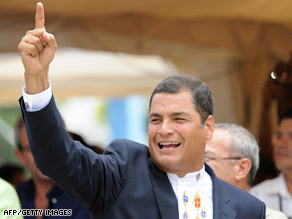
QUITO, Ecuador (CNN) -- President Rafael Correa of Ecuador claimed re-election victory Sunday minutes after the polls closed, calling his apparent win "a day of joy" in which "we have made history."

President Rafael Correa of Ecuador celebrates in Guayaquil on Sunday.

President Rafael Correa of Ecuador celebrates in Guayaquil on Sunday.

Officials results were not expected until later Sunday night.

"We are here for the poor," Correa said in concluding a news conference. "We will never fail you. We will never fail you."

Exit polls broadcast by CNN affiliate Ecuavisa TV showed Correa with more than 50 percent of the vote, leading former President Lucio Gutierrez by nearly 30 percentage points and banana magnate Alvaro Noboa by more than 40 percentage points.

In order to avoid a runoff, a presidential candidate must win more than 50 percent of the vote, or take more than 40 percent of the ballots while beating the second-place finisher by 10 points.

Early results were not available in elections for the 124-seat National Congress, where Correa's Alianza Pais party was expected to do well and could win enough votes to control the legislative assembly.

Gutierrez, who served as president from January 2003 until fleeing the country amid a scandal in April 2005, declined to concede defeat and accused Correa of fraud.

"The whole country said, 'With Lucio we were better and with Correa we are worse,' " Gutierrez said.

He also indicated during a boisterous news conference he may run for president again in four years.

"We must keep fighting for Ecuadorians who want liberty," Gutierrez said. "I am going to continue fighting because we can't let our guard down."

Profile: Ecuador's leading presidential candidates

Ecuador will hold general elections on Sunday to select the country's president, vice president, 124 assembly members, 221 mayors, 46 governors and vice governors and 1,581 municipal councilors.

The followings are the profiles of the three leading presidential candidates.

-- Incumbent President Rafael Vicente Correa Delgado is the most hopeful to win the race, as recent polls showed that he netted some 50 percent of the voters' support. This means he is likely to secure a straight win rather than has to face a second-round election as long as he captures either a majority of the vote or a plurality of more than 40 percent with a margin of at least 10 percentage points over the second-place candidate.

Born in Guayaquil, Ecuador's second largest city, on April 6, 1963, Correa had a master degree got at Belgium's Catholic University of Lovaina. He studied at the University of Illinois, the United States, from 1999 to 2001 and got a Ph.D. there.

He speaks French, English and some Quechua, a major indigenous language in Ecuador.

He served as the country's economy minister in April-August 2005.

Correa was elected president on Nov. 26, 2006, and took office on Jan. 15, 2007 for a four-year term.

On Sept. 28, 2008, Ecuador's new constitution was approved with a majority of "yes" vote in a referendum. His current four-year term was automatically truncated by the new constitution, which opens the possibility for Correa to be re-elected twice and extend his term till 2017.

In his campaign for Sunday's voting, Correa has vowed to take a hard line with foreign investors if he wins the election.


-- Lucio Edwin Gutierrez Borbuda, candidate of the Patriotic Society Party, has a support rate of between 15 percent and 17 percent as was shown by recent polls.

Born in Quito, capital of Ecuador, on March 23, 1957, Gutierrez had studied at the Military College Eloy Alfaro of Quito, the National War Institute of Ecuadorian Armed Forces and the U.S. Inter-American Defense College. He also studied at the War Academy of Ecuadorian Land Forces.

He ran for presidency in 2002 as the candidate of the Jan. 21 Patriotic Society Party and defeated billionaire Alvaro Noboa in the second round. He took office on Jan. 15, 2003 for a four-year term.

But on April 20, 2005, amid strong social protests against Gutierrez's government, the Congress voted to remove Gutierrez from office on grounds that he abandoned his constitutional duties, appointing Vice President Alfredo Palacio to serve as president.

Four days later, Gutierrez arrived in Brazil, then he went to Peru and the United States. In September 2005, he was reported to be seeking asylum in Colombia. But one month later he returned to Ecuador, vowing to "use all legal and constitutional means to retake power."

He was immediately arrested upon his arrival in Ecuador on charges of attempting to subvert Ecuador's internal security by repeatedly proclaiming to the international media that he continued to be the country's legitimate head of state.

Gutierrez was set free on March 3, 2006, after a judge dismissed the charges against him.

Gutierrez, in his campaign this time, said he will keep the dollar as the local currency, create more jobs, reform the Transportation Law, establish a land bank and reduce credit interests.

-- Alvaro Noboa, candidate of the Renewed National Institutional Action Party, has received a support rate of some 12 percent in his fourth efforts to be president.

As Ecuador's wealthiest man, he was born in November 1950 also in Guayaquil. He attended the Institute of Le Rosey in Switzerland, which is famous for educating the children of the richest people in the world, and later entered the Guayaquil State University and graduated as a lawyer. He also took Business Administration courses at the American Management Association in New York.

He has been actively involved in politics, running for president in 1998, 2002 and 2006. In 2007 he was elected national assemblyman.

Noboa said he will, if elected, set a model of free economy with incentives to national and foreign investors, and create a majority middle class in the country.

Source:Xinhua

Ecuador’s president orders U.S. official expelled


By Alexandra Valencia

Ecuadorean President Rafael Correa ordered a U.S. Embassy official expelled on Saturday [ April 18th] after accusing him of interfering in the country’s affairs, a move that will test ties with Washington.

Correa, a leftist, has generally kept good relations with the United States as his socialist allies in Bolivia and Venezuela often clash with Washington over what they say is U.S. "imperialism" in Latin America.

"Foreign minister, give this gentleman 48 hours to pack up his suitcases and get out of the country," Correa said during his weekly media address. "We’re not going to let anyone treat us as if we were a colony here."

He said U.S. official Armando Astorga had abruptly ended a financing agreement with local police after authorities rejected his attempts to handpick officers he wanted to manage the U.S. aid projects.

"Mr. Astorga, keep your dirty money. We don’t need it. We have dignity in this country," Correa said. "Ecuador doesn’t need charity from anyone."

The U.S. State Department was aware of the announcement and checking into it, spokesman Fred Lash said.

The United States is Ecuador’s main trading partner and the destination for much of its petroleum and banana exports.

Correa, a U.S.-trained economist who faces reelection in April, has bolstered his strong popularity in the past by taking a tough stance against what he deems to be interference from neighboring governments or multinational companies.

There has been tension with Washington since Correa vowed not to renew a lease ending this year on a coastal air base used by U.S. forces for counternarcotics missions.

Correa said on Saturday he would allow U.S. Coast Guard planes to land there if needed, but only if Ecuador was allowed to approve of the pilots.

The former college professor is known for his quick temper, ejecting a journalist from a live interview and ordering the arrest of people he charged had hurled insults or made offensive gestures at his presidential motorcade.

Correa has been tough on foreign companies by repeatedly threatening to expel them over contractual disagreements or legal disputes. Last year, he kicked out Brazilian building firm Odebrecht and sent troops to seize its projects in Ecuador.

Venezuelan President Hugo Chavez, a standard-bearer for anti-U.S. sentiment, last year expelled the U.S. ambassador to Caracas and Bolivian President Evo Morales kicked out the U.S. envoy in September after accusing him of fanning civil unrest.

Ecuador's president poised to win a new term

Rafael Correa is set on remaking his Andean nation, where 40% of the population lives in poverty
guardian.co.uk, Friday 24 April 2009

Ecuador's president Rafael Correa is poised to win re-election on Sunday, quite a feat in a politically turbulent country that's run through eight presidents in the past 13 years.

Correa, however, has loftier ambitions than simply holding on to power.

He's set on remaking his poor Andean nation, which is both the world's biggest banana exporter and the smallest member of the Organisation of Petroleum Exporting Countries oil cartel. Nearly 40% of Ecuador's population lives in poverty.

"This citizen's revolution is moving forward, and nobody will stop it!" Correa shouted at a recent campaign stop in Guayaquil, his hometown.

A socialist who's close to Venezuela's Hugo Chavez, Correa is redistributing wealth from the rich to the poor, extending state control over the economy and encouraging more investment by Ecuadorean companies at the expense of foreign investment. However, an economy sliding into recession following the steep drop in oil prices will test his ability to achieve those goals.

Correa has acted boldly in his two years as president.

A 46-year-old who has a PhD in economics from the University of Illinois, he's defaulted on a portion of Ecuador's debt, saying it was contracted illegally years ago.

Correa has angered US policymakers by refusing to renew a US anti-drug air base in Ecuador and by expelling two US diplomats who he said were meddling in the country's politics.

Originally elected in late 2006 with no supporters in Ecuador's congress, Correa won a public vote to rewrite the constitution more to his liking. His supporters are likely to win a majority of seats in congress. This would mark the first time since the return of democracy in 1979 that a president enjoyed a congressional majority.

Correa enjoys unprecedented popularity. He's spent liberally on behalf of the poor, including two increases in the minimum wage. His government has built or refurbished hundreds of schools and local health care clinics.

Correa's popularity has kept his two main opponents in Sunday's election, former president Lucio Gutierrez and perennial candidate Alvaro Noboa, from gaining much traction. Few analysts expect them to hold Correa below 50% to force a runoff election with the second-place finisher.

Correa's popularity also has protected him against revelations that a then-deputy minister of internal security met several times with a top official of the Farc, Colombia's biggest Marxist rebel group, and then was arrested for ties to drug traffickers.

Turnout is expected to be high: around 70%, since in theory, voting is mandatory. The first exit polls will be broadcast just after polls close in the evening.

Ecuador's Correa expected to glide to re-election

GUAYAQUIL, Ecuador (AP) — President Rafael Correa's radical transformation of once unstable Ecuador, including a new constitution that would grant him greater powers, is expected to propel the leftist economist to easy re-election on Sunday.

The 46-year-old Correa, who blames the global economic crisis on capitalism's "structural flaws," has spooked foreign investors with a moratorium on debt payments and tough dealings with oil companies and other multinationals.

He has imposed some of the world's strictest protectionist measures to shield local industries, and critics predict that his huge social spending agenda will bust the Treasury as recession takes hold this year.

But it is precisely such actions that have made the U.S.- and Belgium-educated Correa, a little-known economy minister just four years ago, so popular.

"Let's bury the party-docracy," he told supporters Thursday night as campaigning ended, his buzzword for the traditionally corrupt politics-as-usual that he has long eschewed.

Since taking office in January 2007, Correa has tripled state spending on education and health care, doubled to $30 a monthly payment for single mothers and launched subsidy programs for small farmers and people building their own homes.

Luis Ariolfo Hugo, 73, said he's voting for Correa because "he's sincere and has provided what others didn't. He lowered the price of electricity, he gave us subsidies, he's kept all his promises."

Pre-election polls show Correa more than 20 percentage points ahead of his closest rival, former president and coup leader Lucio Gutierrez. Banana magnate Alvaro Noboa, whom Correa defeated in 2006, was running a distant third.

To win without forcing a runoff, Correa needs more than 50 percent of the vote or at least 40 percent with a 10-point margin over his closest competitor.

Under the country's new constitution, approved by 64 percent of voters in a September referendum, Correa would be eligible to run for a second consecutive four-year term in 2013. His current four-year term was automatically truncated by the new constitution.

Voters on Sunday will also choose mayors, governors and a new 124-seat National Assembly. Six of those legislative seats will represent the Ecuadorean diaspora. The new constitution also lowers the voting age to 16 and for the first time permits soldiers, police and prison inmates to vote.

Correa's critics acknowledge his popularity in this Andean nation of 14 million, but warn that like his ally, Venezuelan President Hugo Chavez, he benefited politically from oil prices that skyrocketed last year but have since come down to earth.

Ecuador's oil-based economy grew 6.5 percent last year according to the government, but the country's petroleum revenues have dropped 67 percent in the first quarter of 2009.

Correa's governing model "has been successful in its redistribution of wealth and for directing resources to social programs but not so successful in creating new types of productivity," said Vladimir Sierra, head of the sociology department at Quito's Catholic University.

His most controversial move has been to default on interest payments for 32 percent of Ecuador's $10.1 billion in foreign debt. The government said Monday that it would seek to buy back that debt at 30 cents on the dollar.

"Correa has contributed to Ecuador's isolation, lowering confidence for investment, spurring capital flight, reducing lines of credit and prompting people to turn to the mattress-bank" — keeping their money at home, in cash, said Ramiro Crespo of Analytica Securities.

Many economists believe Correa's policies will force Ecuador to abandon the dollar as its national currency. Ecuador is the world's largest dollar-based economy outside the U.S.

Critics of Ecuador's new constitution complain that the Correa allies who drafted it concentrated more power in the presidency, vesting the chief executive with many budgetary responsibilities that were formerly the province of congress. The central bank's independence was also diminished.

But many analysts say a strong executive is exactly what Ecuadoreans want after so many years of corrupt and inefficient governments. The country has had 10 presidents since 1997 — three of them ousted by popular revolts, including Gutierrez, a former army colonel.

"Correa's success is that he has combined change with order," said Jorge Leon, an independent political analyst. "His government is tough, quite authoritarian, which in the collective imagination confers the idea of order."

Correa has been a particularly demanding boss when it comes to the economy. The current finance minister is his fourth.

Chevron Lobbyists Misleading USTR Over Ecuador Environmental Case

Amazon Defense Coalition

FOR IMMEDIATE RELEASE 2009-04-23

Amazon Defense Coalition
Karen Hinton, 703-798-3109
Karen@hintoncommunications.com

Chevron Deceiving U.S. Government to Protect Ill-Gotten Profits in Ecuador, Indigenous Groups Say

Chevron Lobbyists Misleading USTR Over Ecuador Environmental Case

Washington, D.C. (April 23, 2009) -- A team of prominent Chevron lobbyists are again misleading the U.S. Trade Representative as part of a campaign to retaliate against Ecuador's government for refusing to interfere in a private environmental lawsuit against the oil giant, representatives of Amazonian communities say.

The controversy concerns a petition recently submitted by Chevron to Ron Kirk, the newly confirmed USTR ambassador and former Mayor of Dallas, asking that trade preferences for Ecuador be canceled because Ecuador's President has not quashed a private class action lawsuit brought by 30,000 rainforest residents in Ecuador's courts. The 15-year-old case, which was transferred to Ecuador from U.S. federal court in 2002 at Chevron's request, is expected to conclude this year with a multi-billion dollar judgment against the oil giant.

A loss of trade preferences for Ecuador would cost the country 350,000 jobs in a country with a total population of 12 million, according to Ecuador's government.

A court-appointed team of technical experts in Ecuador recently assessed damages against Chevron at up to $27 billion, a possible record for an environmental case. Chevron is accused of dumping billions of gallons of toxic waste into Amazon waterways over a 26-year period, leading to a dramatic increase in cancer, decimating indigenous groups, and despoiling an area of ecosystem the size of Rhode Island.

Chevron's USTR lobbying campaign is "based on misrepresentations, is an affront to the rule of law in two countries, and is a continuation of a decades-long abuse of the people of Ecuador", said a letter sent to Kirk by Ecuadorian advocates for dozens of communities and indigenous groups. Similar campaigns by Chevron to cancel Ecuador's trade preferences failed in 2006 and 2008.

The Amazonian representatives asked Kirk to refer Chevron's petition to authorities to determine if the company is making false statements to the executive branch in violation of federal law.

"Chevron is asking the U.S. government to pressure Ecuador's President to interfere with his country's independent judiciary to quash a private legal case," said Steven Donziger, an American legal advisor to the plaintiffs. "Such action would violate Ecuador's Constitution and result in an impeachable offense for Ecuador's President.

"This is a classic example of a large oil company trying to manipulate the U.S. government's foreign policy to protect its own ill-gotten profits in Ecuador," said Donziger.

The letter pointed to two primary "misrepresentations" by Chevron to the USTR:

o Chevron claims it was released by Ecuador's government in 1995 from any clean-up obligations. In reality, the express language of the "release" does not cover claims brought by private individuals against the company. No court in the U.S. or Ecuador has ever accepted Chevron's claims about the scope of the release.

o Chevron claims it "remediated" the environmental damage in the mid-1990s despite the fact a team of court experts found the remediation was at best ineffective, and at worst a fraud. Two Chevron lawyers and seven former Ecuadorian government officials are under indictment for lying about the remediation results.

"Chevron's submission to the USTR is a key component of its lobbying and political campaign to intervene in, and undermine, a pending legal matter in Ecuador," according to the letter sent to Kirk. "We ask your office to reject this effort by Chevron as an inappropriate attack on the rule of law."

Chevron spent $6.8 million lobbying in Washington in the first quarter of the year -- more than any other company in the country other than Exxon.

Chevron's high-powered lobbyists on the issue include Mack McLarty, former chief of staff to President Bill Clinton; former Senators John Breaux and Trent Lott; Wayne Berman, who served as the national finance chair for Sen. John McCain's presidential campaign; and several members of the company's government relations staff in Washington.

Several months ago, a Chevron lobbyist created a major stir by being quoted anonymously in Newsweek as saying, in regard to Chevron's potential environmental liability in Ecuador: "We can't let little countries screw around with big companies like this -- companies that have made big investments around the world."

Search this edition Search query Go Thursday, April 23rd 2009 - 9:49 pm UTC Correa and his revolution poised for easy re-election in Ecuador

Mercopress, Thursday, April 23rd 2009

Ecuadorean President Rafael Correa is poised to easily win re-election on Sunday, according to the latest public opinion polls which show he has about 50% support and way ahead of his seven rivals.

Correa needs to score more than 40% of valid cast votes and a ten percentage point margin to avoid a run-off vote with the second-placed candidate. His closest two contenders are former president Lucio Gutierrez and millionaire Alvaro Noboa.

Correa who defines himself as Socialist (with a strong Catholic education) and former economy minister remains widely popular --despite the global economic downturn-- because of his plans to help the poor and pledges to battle a political old guard many blame for Ecuador's chronic instability.

The US-trained economist was elected late in 2006 and has now outlasted his last three predecessors, who were ousted after street protests and political turmoil in the world's top banana exporter.

“Nobody is going to stop this revolution which is moving ahead strongly” said Correa earlier this week at the closing rally of his campaign.

A government-controlled constitutional assembly called for the April 26 ballot last year to further consolidate Correa's policies and influence over state institutions and the economy.

The opposition initially refused to participate in the vote because it felt Correa controlled the process, but it later reversed course. Hundreds of seats at the municipal, provincial and national levels also are up for grabs on Sunday.

If re-elected to a fresh four-year term, Correa is expected to maintain his aggressive stance against foreign investors and populist policies even as the country reels from the impact of the global financial crisis.

Cedatos-Gallup's last poll in early April showed Correa with 49% support, while Noboa and Gutierrez had 13 and 15 percent respectively.

“We’ve managed quite well this crisis which is not of our making, but some would have liked to see the national government fail, but we haven’t and it won’t happen”, said Correa to the cheering crowd, emphasizing the social policies of his administration.

“First of all our people, the social sectors, then servicing debt…for the first time in decades servicing social policies and investment is far higher than servicing our foreign debt”, added the president. Ecuador suspended service payment of some sovereign bonds alleging they were “illegitimate” and offered a repurchase with a 70% face value discount.

“At last power is in the hands of its legitimate owners, the Ecuadorean people and above all the poorest of our people”, he underlined.

OPEC member Ecuador exports half a million barrels per day and is one of the poorest countries of the South American continent.