Guantanamo, Jan 26 (CMKS).- Ecuadorian President Rafael Correa was ratified as the first candidate for reelection as president in Ecuador, after an unprecedented primary election conducted by the governing Alianza Pais party on Sunday.
Manuela Gallegos, head of the electoral process, said “We believe that the vote has been a success and that from it President Correa and Vice President Lenin Moreno were chosen as the Alianza Pais candidates for the April 26 general elections,” the first to be held under the
country’s new constitution approved by voters last September, reported AFP according to Granma newspaper.
Correa headed a list of 14,000 candidates for diverse posts. “It’s the first time that a movement, with total transparency, carries out a primary election to select the best men and women as candidates of all Ecuadorians,” said the president after casting his ballot in Quito.
Correa recently completed his first two years in office with a record 70 percent approval among the population. In the primary election on Sunday, 9.7 million Ecuadorian were eligible to vote.
Tuesday, January 27, 2009

Ecuador´s Ruling Party Picks Candidates
Quito, Jan 25 (Prensa Latina) Ecuador´s ruling party Alianza Pais on Sunday is holding primary elections to choose candidates for April, 2009 general elections.
There is no precedent in Ecuador history for such a process, so there might be some mistakes, President Rafael Correa warned on Saturday, after asking his followers to be cautious and patient.
"Let’s vote and elect the best candidates for the April 26th Elections", the Ecuadoran leader expressed.
Correa is one of the candidates for Presidency for the Alianza Pais party.
Let’s all vote, AP party followers or not", he stressed after recalling that those elected in the primary elections will be elegible for public posts like mayors, governors and even the presidency.
About 1.8 million Ecuadorans are expected to vote in April general elections.
Ecuador Congress for Mining Veto
 |
Observers analysis of this legislation cannot be carried out January 21, as initially expected, due to the lack of quorum, and parliamentary leader Fernando Cordero suspended the session.
It is expected that assembly members back the veto, in favor of a change in its wording, Cordero said some days ago.
The text of that proposal states that "we will revert to the State projects in which the country has made explorations and studies of prefeasibility and feasibility," but instead of "and" we must write "or," he noted.
That change would strongly reverse mining concessions to the country, because the mistake committed by assembly members has generated a sense contrary to what all Ecuadorians must be inclined: the defense of natural resources, Cordero stressed.
For the legislative president, this rule will boost a responsible mining industry, to care environment and water resources.
The Ecuadorian head of State stated this weekend "that law has all democratic legitimacy, and predicted its approval today to start exploiting the great mining potential the nation has.
Last week the Confederation of Indigenous Nationalities of Ecuador rejected this law, because it begins large scale exploitation and allows the entry of important transnational companies.
Migrant organization criticizes Ecuador's xenophobic decree
QUITO, Jan. 23 (Xinhua) -- A migrant organization said Friday in a statement that the decree issued by Ecuadorian President Rafael Correa to demand Colombian citizens to prove themselves without judicial record while entering Ecuador is unconstitutional.
The Jesuit Service of Refugees and Migrants in Ecuador (SJMR) demanded the resignation of Ecuadorian Interior Minister, Fernando Bustamante, for his xenophobic declarations against the rights of the moving people, according to the statement.
Colombians could freely enter Ecuador till the beginning of last December. However, at present, they must present a certificate of penal record or the so-called "judicial record", issued by Colombian police.
The measure, according to Ecuadorian authorities, is to tackle the instability in the country caused by Colombians.
Under the decree, the judicial record is not requested from minors, legal refugees, plane passengers, government authorities and members of international organizations.
The measure has triggered response from Colombia, as its Foreign Minister Jaime Bermudez said it was discriminatory and stigmatizing and broke some of the treaties in the Andean Community.
The SJMR considered that it was necessary and urgent for the government to implement mechanism of migratory regulation, based on the new Constitution, which promotes the social integration of the immigrant people and full exercise of their rights.
Colombia and Ecuador have been keeping severe ties since March 1, 2008, when Colombia bombed a rebel camp located in Ecuador without notice, violating the Ecuadorian sovereignty.
PetroEcuador to Cut 1,500 Jobs
LAHT, 23 January, 2008
QUITO -- State oil company Petroecuador will carry out a restructuring plan that includes eliminating 1,500 jobs, Ecuadorian President Rafael Correa said, adding that just $3 billion will be earmarked for the firm this year to fund ongoing projects.
Correa, who held a meeting Thursday with Petroecuador's board, told reporters the job cuts were regrettable and said the number of jobs lost could vary once the recommendations of a study carried out by U.S. research and consulting firm Wood Mackenzie are adopted.
The president said that for the government "it is very painful that there are people who will lose their jobs, but more painful yet is that it is a blow to the common good, just as was the irresponsibility of the different governments who used Petroecuador as part of a political spoils system" and increased its payroll.
The government "has to look out for the common good; we won't leave them alone, but Petroecuador can't continue with 5,000 people," Correa said.
The president also said that Ecuador will earmark $3 billion this year - a drop of nearly $2 billion from the amount approved for 2008 - for Petroecuador's operating costs and ongoing projects, noting that the global financial crisis makes it impossible to raise that budget for the carrying out of new projects.
"We're prioritizing (ongoing) projects, but obviously if Petroecuador wants to invest in other projects it can invest in whatever it wants as long as it can obtain financing through bids and strategic alliances," Correa said.
Oil is Ecuador's main export, and the Andean nation currently produces an average of about 500,000 barrels per day of crude, of which state-owned Petroecuador accounts for just over 50 percent.
Revenue from oil exports finances roughly 35 percent of Ecuador's public spending. EFE
QUITO -- State oil company Petroecuador will carry out a restructuring plan that includes eliminating 1,500 jobs, Ecuadorian President Rafael Correa said, adding that just $3 billion will be earmarked for the firm this year to fund ongoing projects.
Correa, who held a meeting Thursday with Petroecuador's board, told reporters the job cuts were regrettable and said the number of jobs lost could vary once the recommendations of a study carried out by U.S. research and consulting firm Wood Mackenzie are adopted.
The president said that for the government "it is very painful that there are people who will lose their jobs, but more painful yet is that it is a blow to the common good, just as was the irresponsibility of the different governments who used Petroecuador as part of a political spoils system" and increased its payroll.
The government "has to look out for the common good; we won't leave them alone, but Petroecuador can't continue with 5,000 people," Correa said.
The president also said that Ecuador will earmark $3 billion this year - a drop of nearly $2 billion from the amount approved for 2008 - for Petroecuador's operating costs and ongoing projects, noting that the global financial crisis makes it impossible to raise that budget for the carrying out of new projects.
"We're prioritizing (ongoing) projects, but obviously if Petroecuador wants to invest in other projects it can invest in whatever it wants as long as it can obtain financing through bids and strategic alliances," Correa said.
Oil is Ecuador's main export, and the Andean nation currently produces an average of about 500,000 barrels per day of crude, of which state-owned Petroecuador accounts for just over 50 percent.
Revenue from oil exports finances roughly 35 percent of Ecuador's public spending. EFE
Ecuador Taxing Strategic Imports
 |
The measure decided in past days with the business sector establishes an increase of taxes from 30 to 35 percent for articles, imported fruits and food, aimed at limiting these purchases.
This that is temporary, allows the country from having to spend 1.459 billion dollars and also to search for an increase of its exports allowing access to a liquidity of its finances, pointed out the Economics coordinator, Diego Borja.
Perfumes, alcoholic beverages, biscuits, toys, disposable diapers, pencils, notebooks, markers, cosmetics, cellular phones, shoes, clothing and car parts now are charged 30 to 35 percent in taxes, informed the Official Gazette in its Thursday issue. Added to the list are products such as sanitary napkins, fruits and creams, among others.
In addition to raising taxes the government place a 65 percent limit on the import of cars, electric appliance and other equipment.
This measure that will be applied for one year generates uncertainties among the retail businesses with the announcement of an increase in price of articles added to the higher taxes.
The government also announced that it began a publicity campaign to boost public consumption of national products to stimulate local production.
President Rafael Correa pointed out a few days ago that the decision was made to guarantee the necessary revenue for the economy and prevent an excessive loss of foreign currency.
The Industry minister, Xavier Abad, stressed that the taxes set are absolutely reasonable and announced a strengthening of controls to prevent contraband.
Abad denied a possible shortage of the internal market since, by limiting purchases, local production is boosted.
ECUADOR: Indigenous Groups Protest Government Policies
By Kintto Lucas
QUITO, Jan 22 (IPS) - Since the start of his term in January 2007, Ecuadorean President Rafael Correa has had touchy relations with the indigenous peoples' movement, in spite of the fact that it backed his election. But passage of a mining law has deepened the rift between them and triggered protests.
In his report this week to the country's interim Congress, a temporary legislature installed after the country's new constitution was approved in September 2008 and that will function until a new Congress is elected, the centre-left president criticised leftwing sectors and indigenous leaders who are opposed to the mining law.
"Where does the biggest danger to the citizen revolution lie? In the infantile left, the infantile pro-indigenous movement, the infantile ecological movement, which have become active again, holding meetings to push for an uprising opposed to mining," the president has stated.
In a speech from the balcony of the seat of government to hundreds of people this week, Correa said he would accept protests if they were peaceful, but emphasised that he would not allow roadblocks, like those carried out by the indigenous movement in different parts of the country on Tuesday.
"With this law in hand, we will not allow these abuses, we will not allow uprisings, roadblocks, attacks on private property, or obstacles to an activity (mining) that is legal and that is being regulated," he said.
The indigenous movement is opposed to the new mining law because they argue that it is based on a model of large-scale extraction which will affect the environment, pollute water and plunder the natural wealth of the country while providing hardly any benefits to Ecuadoreans, and only benefiting foreign corporations.
The business community is also critical of the mining law, but in their case because they believe it puts mining in Ecuador at a disadvantage compared to competitors in Peru and Chile, for example.
But the government considers that extractive industries such as gold and copper mining are of essential importance to the country's development.
Humberto Cholango, the head of Ecuarunari, an association of Quechua peoples from the Andes highlands and the largest member organisation of the powerful Confederation of Indigenous Nationalities of Ecuador (CONAIE), told IPS that "unfortunately" the government has not been willing to enter into dialogue and the president is surrounded by "rightwing" leaders.
CONAIE, which represents 90 percent of the indigenous peoples' movement, is divided into three regional branches, for the highlands, the coast, and the Amazon jungle areas - Ecuador's three main geographical divisions.
"The president has only to look around him if he wants to see representatives of the right," said Cholango, referring to certain ministers and secretaries who were formerly linked to rightwing sectors.
"The indigenous peoples' movement has fought against the neoliberal model for many years. It has faced repression and members have been killed under different governments, but it has maintained its dignity," he said, clarifying that Tuesday’s protest was not organised to destabilise the government, but to urge it to "correct its course."
Cholango said Correa raised hopes when he took office two years ago, but that he has been incapable of understanding the country’s indigenous people.
"We are open to dialogue. This protest demonstration is against the neoliberal model and against laws that oppose change, like the mining law which endangers water sources, or the food sovereignty law which favours agribusiness monopolies," he said.
He said the protesters were demanding, above all, discussion of the draft water law presented by the indigenous movement, which seeks to conserve and protect water resources.
"We do not accept that a government that says it is in favour of marginalised people should not take their views into account when it makes laws. It's inconceivable that laws as important as those on mining or food sovereignty should be passed without public debate, or that they should contain articles that run counter to the constitution itself, which enshrines the rights of nature," he said.
Urban and youth movements as well as environmental and human rights organisations joined in CONAIE's protest on Tuesday.
The Council of Evangelical Indigenous Peoples and Organisations of Ecuador (FEINE), the second-largest indigenous group, expressed agreement with CONAIE's demands. Its head, Marco Murillo, complained about the total lack of social participation in lawmaking and in the government.
The other, and final, component of the indigenous peoples' movement is the National Federation of Peasant, Indigenous and Black Organisations (FENOCIN), linked to the Socialist Party, which has a much weaker social influence. Some of its leaders occupy mid-level government posts.
Political analyst Alejandro Moreano said Ecuador’s indigenous movement is the country’s largest social movement and one of the most powerful in Latin America.
"It was the indigenous movement that kept the fight against neoliberalism alive in the 1990s, and it has a very substantial social base," he told IPS.
Tuesday’s protests included roadblocks at different points of the highways joining the highlands with the Pacific coast and Amazon regions, and were deemed a success by indigenous leaders. Four protesters and six policemen were injured in clashes, according to local press reports.
QUITO, Jan 22 (IPS) - Since the start of his term in January 2007, Ecuadorean President Rafael Correa has had touchy relations with the indigenous peoples' movement, in spite of the fact that it backed his election. But passage of a mining law has deepened the rift between them and triggered protests.
In his report this week to the country's interim Congress, a temporary legislature installed after the country's new constitution was approved in September 2008 and that will function until a new Congress is elected, the centre-left president criticised leftwing sectors and indigenous leaders who are opposed to the mining law.
"Where does the biggest danger to the citizen revolution lie? In the infantile left, the infantile pro-indigenous movement, the infantile ecological movement, which have become active again, holding meetings to push for an uprising opposed to mining," the president has stated.
In a speech from the balcony of the seat of government to hundreds of people this week, Correa said he would accept protests if they were peaceful, but emphasised that he would not allow roadblocks, like those carried out by the indigenous movement in different parts of the country on Tuesday.
"With this law in hand, we will not allow these abuses, we will not allow uprisings, roadblocks, attacks on private property, or obstacles to an activity (mining) that is legal and that is being regulated," he said.
The indigenous movement is opposed to the new mining law because they argue that it is based on a model of large-scale extraction which will affect the environment, pollute water and plunder the natural wealth of the country while providing hardly any benefits to Ecuadoreans, and only benefiting foreign corporations.
The business community is also critical of the mining law, but in their case because they believe it puts mining in Ecuador at a disadvantage compared to competitors in Peru and Chile, for example.
But the government considers that extractive industries such as gold and copper mining are of essential importance to the country's development.
Humberto Cholango, the head of Ecuarunari, an association of Quechua peoples from the Andes highlands and the largest member organisation of the powerful Confederation of Indigenous Nationalities of Ecuador (CONAIE), told IPS that "unfortunately" the government has not been willing to enter into dialogue and the president is surrounded by "rightwing" leaders.
CONAIE, which represents 90 percent of the indigenous peoples' movement, is divided into three regional branches, for the highlands, the coast, and the Amazon jungle areas - Ecuador's three main geographical divisions.
"The president has only to look around him if he wants to see representatives of the right," said Cholango, referring to certain ministers and secretaries who were formerly linked to rightwing sectors.
"The indigenous peoples' movement has fought against the neoliberal model for many years. It has faced repression and members have been killed under different governments, but it has maintained its dignity," he said, clarifying that Tuesday’s protest was not organised to destabilise the government, but to urge it to "correct its course."
Cholango said Correa raised hopes when he took office two years ago, but that he has been incapable of understanding the country’s indigenous people.
"We are open to dialogue. This protest demonstration is against the neoliberal model and against laws that oppose change, like the mining law which endangers water sources, or the food sovereignty law which favours agribusiness monopolies," he said.
He said the protesters were demanding, above all, discussion of the draft water law presented by the indigenous movement, which seeks to conserve and protect water resources.
"We do not accept that a government that says it is in favour of marginalised people should not take their views into account when it makes laws. It's inconceivable that laws as important as those on mining or food sovereignty should be passed without public debate, or that they should contain articles that run counter to the constitution itself, which enshrines the rights of nature," he said.
Urban and youth movements as well as environmental and human rights organisations joined in CONAIE's protest on Tuesday.
The Council of Evangelical Indigenous Peoples and Organisations of Ecuador (FEINE), the second-largest indigenous group, expressed agreement with CONAIE's demands. Its head, Marco Murillo, complained about the total lack of social participation in lawmaking and in the government.
The other, and final, component of the indigenous peoples' movement is the National Federation of Peasant, Indigenous and Black Organisations (FENOCIN), linked to the Socialist Party, which has a much weaker social influence. Some of its leaders occupy mid-level government posts.
Political analyst Alejandro Moreano said Ecuador’s indigenous movement is the country’s largest social movement and one of the most powerful in Latin America.
"It was the indigenous movement that kept the fight against neoliberalism alive in the 1990s, and it has a very substantial social base," he told IPS.
Tuesday’s protests included roadblocks at different points of the highways joining the highlands with the Pacific coast and Amazon regions, and were deemed a success by indigenous leaders. Four protesters and six policemen were injured in clashes, according to local press reports.
Ecuador to cut oil investment, seek financing
By Jose Llangari
PUEMBO, Ecuador, Jan 22 (Reuters) - Squeezed by crashing oil prices, OPEC member Ecuador will slash spending on its key oil sector while it seeks foreign investment, President Rafael Correa said on Thursday.
Correa said his government will earmark around $3 billion for the annual budget of state oil company Petroecuador. In 2008, the leftist government initially approved a $4.8 billion budget for Petroecuador to boost dwindling production.
"We are prioritizing ... we gave them (Petroecuador) $3 billion for operations and investment, but they can invest as much as they can if they are able to get financing via bids or strategic alliances," Correa said. "We have many profitable projects and I'm sure there will be many people interested."
Lower state spending could hurt the Andean country's oil production which has been battered already by falling private investment.
Correa, a popular socialist, boosted state control over the oil sector in a move that analysts say has scared off billions of dollars in private investment since he took office in 2007.
Ecuador has pushed foreign oil companies to rework new deals to give the government a bigger share of oil revenues. However, the government has not yet convinced them to switch to service deals in which the state keeps all their production.
Oil Minister Derlis Palacios said Petroecuador will have to invest only in ongoing and strategic projects such as an upgrade of it 100,000 barrels-per-day capacity Esmeraldas refinery.
"We had to reorganize the budget ... at first we expected a $4.5 billion (budget) or this year," Palacios told reporters. "We will keep ongoing and strategic projects."
In a previous radio interview, Palacios said he saw no benefit for Ecuador under current world oil prices if OPEC decides to slash output again at its next meeting.
Palacios said Petroecuador aimed to keep production levels unchanged this year, but he did not specify if he meant output from all projects currently operated by the state.
Petroecuador's production arm, Petroproduccion, produced around 174,000 barrels of oil per day in November. Petroamazonas, a state-run firm that operates an oil bloc formerly owned by Occidental Petroleum, produced around 102,000 bpd during the same month.
Alianza Pais Readies for Elections in Ecuador
Quito, Jan 22 (Prensa Latina) The movement Alianza Pais (AP), led by Ecuadorian President Rafael Correa, is ready for the primary elections next Sunday.
Ten thousand precandidates nationwide are running for a popular candidacy, said Policy Minister Ricardo Patiño, one of the main AP leaders.
It is an unprecedented process in this country and this political organization will be the only one that will hold open primary elections, he added.
Patiño called on people to participate in the January 25 elections to elect the AP candidates to some 6,000 posts.
He pointed out that the elections will be financed with 2,757,289 dollars handed over by the National Election Council (CNE).
Six million ballots will be distributed in 2,400 electoral colleges throughout the country, so that people can vote for the AP candidates to public posts.
Manuela Gallegos, president of the AP Election Tribunal, said participation would be voluntary for the party's members and supporters, and for citizens over 16 years of age who have registered to vote.
Results will be made public four days after the elections, and candidates will be immediately registered at the CNE.
Voters will elect the candidates to the presidency and vice presidency of the Republic, national and provincial assemblies, town halls, councils and parochial boards.
Although Correa has no rivals within the AP, his name was included in one of the ballots, as a way to know how much popular support he gets.
U.S. ratifies military withdrawal from Ecuadorian base
QUITO, Jan. 21 (Xinhua) -- The United States has ratified a proposal to withdraw its military staff deployed in the Ecuadorian base of Manta, possibly "before November," U.S. ambassador Heather Hodges said Wednesday.
In 1999, Ecuador authorized the United States' use of the Mantabase for 10 years to combat drug trafficking.
Hodges said the United States had not found an alternative to replacing the anti-drug Manta base.
"What we are going to do to replace the Manta base is still unknown," she told local TV channel Ecuavisa.
Ecuadorian President Rafael Correa's decision not to extend the garrison agreement had been severely criticized by the U.S. government.
Correa plans to prohibit foreign military bases on Ecuadorian territory, a law relating to which will be included in the country's new constitution.
"I should stand up and recognize the immense respect of the U.S. government for our decision ... They have agreed to withdraw from the base before November 2009," Correa told the nation.
Despite the end of the agreement, Washington will continue to support Ecuadorian efforts against drug trafficking. "That fight is going very well and it will continue," Correa said.
U.S. militaries operating from the Manta base have detained several ships and mini-submarines ferrying drugs in the Pacific and seized 1,617 tons of cocaine since 2000, according to the embassy in Quito.
Wednesday, January 21, 2009
Indians Block Ecuador Highways to Protest Mining
LAHT, January 20, 2009
QUITO -- Indian groups in Ecuador started blocking highways before dawn Tuesday in protest against the new mining law, while Interior Minister Fernando Bustamante asked that the demonstrations be carried out peacefully.
The Confederation of Indigenous Nationalities of Ecuador, or Conaie, and some environmental groups called for nationwide protests against the new law, which they believe will harm the environment and favor multinational mining companies.
According to media accounts, indigenous groups began blocking highways at sunrise, above all in the country's Andean region, although government officials said that these demonstrations were not really significant.
North of Quito some 1,000 Indians stalled traffic before dawn on the Pan American Highway with tree trunks and stones, witnesses said.
Those blockades and similar actions have not resulted in any serious clashes with police, authorities said.
Miguel Torres, an Indian leader in the northern province of Imbabura where the police have kept the road to the capital from being cut off, said on Radio Quito that "the blockades will be progressive."
Another Indian leader said on the Teleamazonas network that police stopped demonstrators from entering the capital for a planned demonstration and march to Congress.
"Groups that want to protest against the mining law or anything else can do so, they have the right, they have freedom of expression and can give their points of view, but we are going to require that they do so with respect for law and order," the interior minister said in an interview on Sonorama radio.
"If they block highways or take any other action that keeps people from carrying on with their normal lives, we'll have to intervene and do what the law requires in such cases," Bustamante said.
After the statement President Rafael Correa made Monday that there are groups out to destabilize the government, the minister said that "some leaders" of these groups may have such an intention, but he doesn't believe "that together the demonstrators have that idea."
Correa, a left-leaning, U.S.-trained economist, says the new mining law includes environmental safeguards and accuses the measure's opponents of engaging in "childish leftism and environmentalism."
QUITO -- Indian groups in Ecuador started blocking highways before dawn Tuesday in protest against the new mining law, while Interior Minister Fernando Bustamante asked that the demonstrations be carried out peacefully.
The Confederation of Indigenous Nationalities of Ecuador, or Conaie, and some environmental groups called for nationwide protests against the new law, which they believe will harm the environment and favor multinational mining companies.
According to media accounts, indigenous groups began blocking highways at sunrise, above all in the country's Andean region, although government officials said that these demonstrations were not really significant.
North of Quito some 1,000 Indians stalled traffic before dawn on the Pan American Highway with tree trunks and stones, witnesses said.
Those blockades and similar actions have not resulted in any serious clashes with police, authorities said.
Miguel Torres, an Indian leader in the northern province of Imbabura where the police have kept the road to the capital from being cut off, said on Radio Quito that "the blockades will be progressive."
Another Indian leader said on the Teleamazonas network that police stopped demonstrators from entering the capital for a planned demonstration and march to Congress.
"Groups that want to protest against the mining law or anything else can do so, they have the right, they have freedom of expression and can give their points of view, but we are going to require that they do so with respect for law and order," the interior minister said in an interview on Sonorama radio.
"If they block highways or take any other action that keeps people from carrying on with their normal lives, we'll have to intervene and do what the law requires in such cases," Bustamante said.
After the statement President Rafael Correa made Monday that there are groups out to destabilize the government, the minister said that "some leaders" of these groups may have such an intention, but he doesn't believe "that together the demonstrators have that idea."
Correa, a left-leaning, U.S.-trained economist, says the new mining law includes environmental safeguards and accuses the measure's opponents of engaging in "childish leftism and environmentalism."
Ecuador Indigenous Urged to Protest Peacefully
Quito, Jan 20 (Prensa Latina) Ecuadorian Minister of Government Fernando Bustamante called on the indigenous movement on Tuesday to protest mining laws peacefully and in an organized way.
The National Police was ordered to protect the demonstrators, ensure public order and prevent any attempt to block the roads or use violence, said Bustamante in a press conference with foreign journalists.
Those who want to protest may do it by keeping public order and without attempting against public property, he stressed.
Bustamante said he talked today with President of the Kichwa People Confederation, Humberto Cholango, and reiterated the need for protests in different to be staged without problem.
Ecuadorean indigenous people oppose large scale mining allowed by a legislation approved by the Legislative Commission, as they consider it contaminates the environment and affects water sources.
They also demand the approval of the law on water, with serious regulations for use and the State property over natural resources.
Ecuador to Host Indigenous Anti-Mining March
Quito, Jan 20 (Prensa Latina) Ecuadorian Indigenous and social groups will protest today the Mining Law that Congress approved but President Rafael Correa vetoed.
Today's protests and marches in La Sierra, La Costa and Amazonia provinces were convened by the Confederation of Indigenous Nationalities of Ecuador (CONAIE).
Humberto Cholango, leader of CONAIE branch Kichwa Confederation of Ecuador, said it will be peaceful yet the largest Indigenous protest the president will deal with.
He said the marches are aimed at preventing the presence of large foreign mining companies in the country and open-sky and large-scale exploitation of natural resources that pollute the environment and destroy water sources.
Cholongo said they will urge for Congressional approval of a Law on water to terminate its privatization and hoarding and denied its water or environmental regulations as the government claims.
They will also call to promote agriculture and urged for a true agrarian reform and for land redistribution among indigenous peoples and farmers plus recovering and nationalizing natural resources.
The indigenous leader said they coordinated massive attendance with water commissions, provincial leaders, associations and worker, environment, women and youth organizations.
He also denied involvement of political parties or the oligarchy.
But President Rafael Correa partially vetoed the Law on mining Monday so Congress is to debate Wednesday his observations.Ecuador closer to Iran which promised 200 million USD loan
MercoPress, January 19, 2009
Iran will loan more than 200 million US dollars to Ecuador and will study several investment projects in the country, Ecuador's President Rafael Correa announced during his Saturday radio and television program.
President Correa did not give further details but recalled that last week he met in Quito with an Iranian delegation to analyze the progress of the bilateral accords established in recent months.
"Collaboration with Iran has started to bear fruit" and soon representatives of construction companies from Teheran will arrive to "study the projects in which they want to invest," the president said.
"A loan of more than 200 million USD from Iran to Ecuador is practically certain," he said, mentioning that with Tehran "there is not only financing for trade" but also "cooperation for development".
"There is a new outlook" that includes technology transfer and "many other things," he said.
Ecuador together with Cuba, Venezuela and Bolivia have established closer political and trade links with Iran, as well as strengthening ties with China and Russia, all of which have advanced on Latinamerica, an area traditionally under Washington influence.
President Correa who has signed several pacts with China, acknowledged that the "relationship is being favoured" because the country has "shown interest" in cooperating with Ecuador.
Nonetheless, he said that in a recent evaluation of the situation with Chinese diplomats here it was evident that the accords that were signed have not advanced as planned.
That delay is "part our fault and part China's, which has very slow bureaucratic procedures and processes for taking decisions," Correa said, stressing the renewed bilateral commitment to making quick progress in turning agreements into action
Iran will loan more than 200 million US dollars to Ecuador and will study several investment projects in the country, Ecuador's President Rafael Correa announced during his Saturday radio and television program.
 |
"Collaboration with Iran has started to bear fruit" and soon representatives of construction companies from Teheran will arrive to "study the projects in which they want to invest," the president said.
"A loan of more than 200 million USD from Iran to Ecuador is practically certain," he said, mentioning that with Tehran "there is not only financing for trade" but also "cooperation for development".
"There is a new outlook" that includes technology transfer and "many other things," he said.
Ecuador together with Cuba, Venezuela and Bolivia have established closer political and trade links with Iran, as well as strengthening ties with China and Russia, all of which have advanced on Latinamerica, an area traditionally under Washington influence.
President Correa who has signed several pacts with China, acknowledged that the "relationship is being favoured" because the country has "shown interest" in cooperating with Ecuador.
Nonetheless, he said that in a recent evaluation of the situation with Chinese diplomats here it was evident that the accords that were signed have not advanced as planned.
That delay is "part our fault and part China's, which has very slow bureaucratic procedures and processes for taking decisions," Correa said, stressing the renewed bilateral commitment to making quick progress in turning agreements into action
Ecuador to Finalize Mining Law This Week, Correa Says
By Stephan Kueffner
Jan. 19 (Bloomberg) -- Ecuador’s new mining law will probably be finalized this week, President Rafael Correa said.
The bill will be submitted to the legislature today with a request for a minor change before final approval, Correa said in a speech from the presidential palace in Quito. Correa said he plans to ask the National Assembly to change the wording in the law to make sure that control of some deposits that were explored and studied by the government is returned to the state.
Correa is hoping the new law, which reorganizes the industry after the Assembly banned mining in April, will lure more foreign investment to develop deposits in the South American country.
“We don’t have another single day to lose,” Correa said.
Ecuador estimated in the first quarter of last year that it has some $220 billion in reserves of metals such as gold, copper and molybdenum. Companies will be able to partially restart operations as soon as the law goes into effect, with full activities resuming as soon as regulations to govern the implementation of the measures are ready, Deputy Mining Minister Jose Serrano said.
“They’ll be able to start work immediately,” Serrano said in a telephone interview.
Miners Cheer
Several hundred miners cheered as they heard Correa’s speech in Quito’s Independence Square today. Indigenous groups and protesters concerned that the increase in mining may lead to more environmental damage will hold demonstrations tomorrow against the plans to develop gold and copper deposits.
According to the draft law, the government will have the right to declare a deposit a “special mining area,” giving a new state-owned company preferential access to mineral deposits there for up to four years. The new law will also include a 5 percent royalty on sales and ensure that more than 50 percent of revenue from mining operations goes to the state.
The law gives foreign mining companies investing in Ecuador the same rights as domestic producers and allows individuals and companies to freely prospect for minerals. It also toughens social and environmental standards.
Companies will be allowed to hold concessions as large as 5,000 hectares (12,355 acres), for which they will have to pay annual fees of $5 to $20 per hectare, in addition to royalties and taxes. Companies with current, suspended concessions will have 120 days to renegotiate their contracts with the government, and contracts will be based on reference prices as measured by the London Metal Exchange.
A new government mining regulator will oversee the industry. If a local community opposes a project, the Mines and Oil Ministry will have the right to turn it down.
In Ecuador, Nature now has rights
People and Planet, 19 Jan 2009
by Gar Smith
After many years of environmental destruction especially due to oil extracting activities, Ecuador has approved a new constitution that is the first in the world to extends “inalienable rights to nature.”
In 1997, when Ecuador’s pro-US government announced plans to rev up oil exploitation by a third, all eyes turned to the Yasuni rainforest, home to the country’s largest oil reserve – estimated at 1 billion barrels. The Yasuni is also home to rare jaguars, endangered white-bellied spider monkeys, spectacled bears, and indigenous tribes protected by international treaty.
by Gar Smith
After many years of environmental destruction especially due to oil extracting activities, Ecuador has approved a new constitution that is the first in the world to extends “inalienable rights to nature.”
On September 29, 2008, the Associated Press (AP) reported that Ecuador’s new constitution would “significantly expand leftist President Rafael Correa’s powers.” It wasn’t until the end of a 15-paragraph article that the AP mentioned the new constitution – approved by 65 per cent of voters – “guarantees free education through university and social security benefits for stay-at-home mothers.” Also missing from the AP’s report: any mention that Ecuador’s voters had just ratified the world’s first “eco-constitution,” a pioneering document that, for the first time in human history, extends “inalienable rights to nature.”
Not too long ago, Ecuador would have seemed an unlikely nation to become the birthplace of Earth’s first green constitution. To service its massive debt to US creditors, the World Bank and the International Monetary Fund forced Ecuador to open its Amazon forests to foreign oil companies. Nearly 30 years of drilling enriched ChevronTexaco, desecrated the northern Amazon, and utterly failed to improve the lives of millions of poor Ecuadoreans.
Amazon Watch estimates that Texaco damaged 2.5 million acres of rainforest, left the landscape pitted with 600 toxic waste pits, and polluted the rivers and streams that some 30,000 people rely on. Cancer rates in the area where Texaco operated are 130 per cent of the national norm, and childhood leukemia occurs at a rate four times higher than in other parts of Ecuador.
In 1990, the Siona, Secoya, Achuar, Huaorani, and other indigenous forest-dwellers won title to three million acres of traditional forestland, but the government retained rights to the minerals and oil. In November 1993, indigenous communities filed a $1 billion environmental lawsuit against Texaco, and subsequently demanded a 15-year moratorium on drilling, environmental reparations, corporate indemnification, and a share of oil profits.
First step
| "Live Yasuni" spelt out by 100 people in the heart of this National Park, in support of a plan by the Ecuadorian Government to keep that nation's largest oil reserves in the ground forever, saving Yasuni and millions of tons in carbon emissions. Photo © Lou Dematteis/Spectral Q |
In 1997, when Ecuador’s pro-US government announced plans to rev up oil exploitation by a third, all eyes turned to the Yasuni rainforest, home to the country’s largest oil reserve – estimated at 1 billion barrels. The Yasuni is also home to rare jaguars, endangered white-bellied spider monkeys, spectacled bears, and indigenous tribes protected by international treaty.
In 2007, the new government of President Rafael Correa announced plans to halt oil exploration in the Yasuni, an action Amazon Watch called “a giant first step toward breaking Ecuador’s dependence on oil.” Correa’s proposal marked a shift to making renewable energy the new path for Ecuador’s economic future. The language in the new constitution takes the new policy several steps further.
Ecuador’s radical new constitution features a chapter on the “Rights for Nature” that begins by invoking the indigenous concept of sumak kawsay (good living) and the Andean Earth Goddess: “Nature, or Pachamama, where life is reproduced and exists, has the right to exist, persist, maintain and regenerate its vital cycles, structure, functions and its processes in evolution.” The constitution contains a Nature’s Bill of Rights that includes “the right to an integral restoration” and the right to be free from “exploitation” and “harmful environmental consequences.”
Surprisingly, there is a US connection to this story. The Pennsylvania-based Community Environmental Legal Defense Fund (CELDF), along with the San Francisco-based Pachamama Alliance, spent a year working with Ecuador’s 130-member Constituent Assembly to craft the language that installed ecosystem rights in the heart of the new constitution.
“Today’s environmental laws are failing,” CELDF observes in a section on its Web site. “By almost every measure, the environment today is in worse shape than when the major US environmental laws were adopted over 30 years ago.”
Gaining momentum
CELDF notes that US regulations “treat nature as property under law. These laws legalise environmental harm by regulating how much pollution or destruction of nature can occur.” They don’t forbid pollution, they merely “codify it.” By contrast, Right of Nature laws challenge property law by “eliminating the authority of a property owner to interfere with the functioning of ecosystems that exist and depend upon that property for their existence and flourishing.”
The idea is gaining momentum. Municipalities in Pennsylvania, California, New Hampshire, and Virginia have adopted Right to Nature laws in recent years.
Shannon Biggs of Global Exchange notes “slaves were once also considered property under the law” until Americans understood “we needed to write new laws in order to change … the cultural climate.”
With parrot-flecked jungles containing more than 300 different tree species per hectare, cloud forests of amazing biodiversity, and a border that extends to the Galapagos Islands, Ecuador is the perfect spot for the world’s first eco-constitution. Ecuador has swung a hammer against the chains designed to keep nature in thrall to commerce. It’s time for other nations to pick up the same hammer.
Source: Third World Network Features.
Gar Smith is the editor Earth Island Institute's "eco-zine" The-Edge. This article first appeared in Earth Island Journal, Winter 2009.
Ask the Ecuadorian Government to Protect Human Rights During Upcoming Anti-Mining Demonstration
[via UpsideDownWorld]
| Written by The Ecuador Solidarity Network | |
| Monday, 19 January 2009 | |
 The Ecuador Solidarity Network, an organization based in Canada and the United States, is joining human rights and indigenous peoples organizations in calling on President Rafael Correa to respect human rights during nation wide protests against large-scale mining that will begin on Monday January 19th. The protests will spread from the Amazon and reach Quito, Ecuador's capital, on January 20th. The Ecuador Solidarity Network, an organization based in Canada and the United States, is joining human rights and indigenous peoples organizations in calling on President Rafael Correa to respect human rights during nation wide protests against large-scale mining that will begin on Monday January 19th. The protests will spread from the Amazon and reach Quito, Ecuador's capital, on January 20th. Anti-mining protests earlier this month were met with police violence in the Southern provinces of Azuay, Loja, Zamora Chinchipe and Morona Santiago. A number of activists were beaten and detained, and one leader was critically injured after being shot in the head. The Confederation of Indigenous Nationalities of Ecuador (CONAIE) and a number of farmer and environmental organizations are protesting the recent approval of a mining law by Congress, opening the country to large-scale metal mining. Canadian mining companies would benefit from many of the concessions. The CONAIE and other organizations contend that the new law will allow large-scale mining in protected areas and contaminate critical community water supplies. The CONAIE is also protesting government plans to drill for oil in the Yasuni National Park, the rainforest home of two indigenous communities in voluntary isolation. Following recent statements from the Permanent Assembly for Human Rights (APDH) and the Confederation of Indigenous Nationalities of Ecuador (CONAIE), the Ecuador Solidarity Network calls on activists around the world to support the human rights of protesters demonstrating against large-scale metal mining in Ecuador. The CONAIE emphasizes that the demonstrations will be peaceful and calls on President Correa to not use police or military forces against protesters. E-mail President Rafael Correa and President of Congress Fernando Cordero and ask that the government take preventative action to ensure that protesters' human rights are respected. We also denounce any attempt by right-wing organizations in the U.S. or Canada to opportunistically use the upcoming mobilizations to attack President Correa for motives that have nothing to do with indigenous rights or environmental protection. Please send emails to: Presidencia de la República, Presidente Rafael Correa: Rafael.CorreaDelgado@ Presidencia Legislativa, Presidente de la Comision Legislativa y de Fiscalizacion, Fernando Cordero Cueva: presidencia@ Please send a carbon copy of the messages to ecuadorsolidarity@gmail.com Media Contacts: Ecuador: Jennifer Moore, Ecuador Solidarity Network (593) 8-877-8928 / jenmoore0901@gmail.com Canada: Jamie Kneen, Mining Watch (613) 761-2273 |
Ecuador: Correa Faces Pressure From Indigenous Groups
Milton Ramirez,
Global Voices Online, January 19 2009
Global Voices Online, January 19 2009
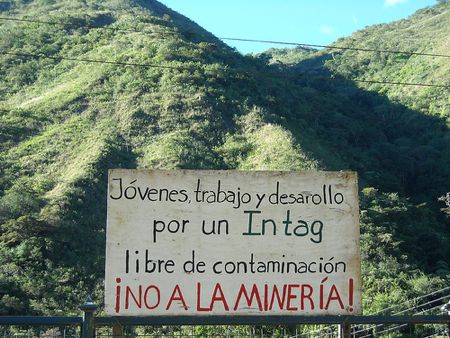
“Young People, Work and Development for an INTAG (cloud forest reserve) free of contamination and free of mining!” Image by d∂wn and used under Creative Commons lisense.
Despite protests and road blockades in southen Ecuador, a new mining law [es] (pdf format) was passed in Congress. Now the new bill will head to the executive branch for final approval from President Rafael Correa. Opposition to the bill is coming from indigenous groups, who have called for a national march to be held on January 20 to protest the government's support for the new law.
The mobilization is being led by the country's largest indigenous organization, the National Confederation of Indigenous Nations (CONAIE), which is stating that there was very little discussion regarding the new law and that it will be harmful to the environment and is going against the sovereignty of indigenous communities. What makes this march especially interesting is that these communities have been generally very supportive of Correa and his administration, and now they are leading the way against his policies.
The last time Ecuador has seen mobilizations of this magnitude was in 2005, when protests forced then-President Lucio Gutiérrez from office. They are even attracting the support of other indigenous groups [es], such as the Indigenous Movement Confederation of Chimborazo (COMICH) in the northern part of the country. Up until now, many of these sectors have been content with President Rafael Correa, but now he is dismissing the actions of these groups led by CONAIE. This confederation, according to blogger Inca Kola is “a smart, canny intelligent political animal” and that it is leading the movement for the promotion of indigenous sovereignty.
One blogger, Fernando Doylet of Madurando Con Sentido [es] is backing the indigenous protests and suggests that local communities decide what is best for their territories and that they should have veto power:
En mi humilde opinion, lo mejor que puede hacer el gobierno (por medio del Ministerio correspondiente) es dejar que los gobiernos locales decidan si autorizan o no la mineria en sus areas geograficas; y si la mayoria de la poblacion rechaza lo que decida el gobierno local, pues que lo cambie.
No creo que ninguna ley deba obligar o negarle sus derechos a los pobladores de un sector; y si tanto le interesa al gobierno central, tiene que ser convencer a la gente, en lugar de simplemente ignorarlos.
In my humble opinion, the best that this government could do (through the proper Ministry) is allow for local governments to decide whether or not they authorize mining in their geographic areas; and if the majority of the population rejects what the local government decides, then they should change it.
I don't think that no law should force or deny the rights of residents of an area; and if it such an interest for the central government, then they must convince the people, instead of simply ignoring them.
Other issues are also at stake. La Voz de Guamote [es] writes about an environmental group Acción Ecológica (Ecological Action) that protested outside the Legislative Palace and participated in a hunger strike. One of the major complaints of this new mining law is that it will jeopardize sources of water for area residents. However, one blogger is making light of this complaint. El Botulista Independiente [es] writes a satirical post regarding solving the water contamination problem:
La explotación de oro y cobre proporcionará al Estado más de cien mil millones de dólares. Con esas cantidades, sin lugar a dudas nos sobrarían recursos para importar agua embotellada. Si bien es cierto que la minería a cielo abierto no es 100 % segura, el gobierno ha previsto la firma de un convenio con la compañía francesa Evian, para asegurar a nuestros campesinos el acceso a agua de la mejor calidad para sus cultivos.
The exploitation of gold and copper will provide the state more than one billion dollars. With that amount, undoubtedly there will be a surplus of resources so that we can import bottled water. While open pit mining is not 100% safe, the government has planned the signing of an agreement with the French company Evian, to ensure that our farmers gain access to the best quality water for their crops.
However, not all indigenous groups are against the new mining law. The community coordinator of the Shuar indigenous group, Antonio Chirias, believes that the new mining law will help his Amazonian community in the country's Orient region [es]. The previously quoted blogger Inca Kola, who writes on economic and banking issues across Latin America believes that the mining law deserves attention and applauds the president, “Correa has done great service to his country via this new law. It banishes the speculators and wide-boys from the scene, it protects the environment (I mean, woe betide any miner that tries to cut corners on this piece of statute) and it will allow Ecuador to grow as a country in a responsible way.”
On January 20, the eyes of the world will be on the U.S. for the inauguration of President-elect Barack Obama and the eyes of Ecuador will be on the marches planned for the same day. President Correa will face a challenge from the protests of groups that have historically supported his government. As B.P.L.E [es] writes:
Veremos como sale parado de ésta el Presidente Correa ahora que debe medirse no con pelucones sino con su mismo “pueblo organizado”
We'll see how President Correa comes out of this, now that he must face not his “opposition” but his very own “organized people.”
Ecuador to Reduce Imports to Curb Crisis
Quito, Jan 18 (Prensa Latina) The Ecuadorian government will reduce imports and increase customs tariffs to reduce the entry of unnecessary goods and prevent commercial retaliations.
Since the Ecuadorian economy was dollarized, the country has imported huge amounts of consumer goods that are often unnecessary, and the current situation, characterized by a drop in oil prices, money remittances and private exports, has become a major problem, according to Minister for Economic Coordinator Diego Borja.
Therefore, due to a decrease in revenues, measures must be taken to overcome the financial debacle, Borja said in the border town of San Lorenzo, where he attended the first itinerant cabinet meeting of this government.
He favored an agreement with the importing sector and admitted that several areas are sensitive to this problem.
The minister ruled out a ban on imports, as President Rafael Correa said a few days ago, because that action may cause commercial retaliations against exports.
We will impose high customs tariffs that will contribute to reducing imports of unnecessary goods to reduce the trade deficit and prevent the vulnerability of public finance, he noted.
This measure is also aimed at defending the national industry, said the minister, who ruled out rumors about the non-dollarization of the Ecuadorian economy.
Borja added that customs tariffs on some 300 products will be increased, and the importing sector will be informed about that decision.Ecuador: Dollarization Stays for Now
Quito, Jan 17 (Prensa Latina) The president of the Ecuadorian Central Bank (BCE), Carlos Vallejo, denied that Ecuador would abandon the dollar system or create create a dual-monetary system.
"I want to stop speculations by groups interested in destabilizing the government. We are not going to abandon the US dollar," Vallejo told media.
He said a Monetary System reform bill reported by the newspaper Hoy had been studied in 2007.
It was rejected based on the new Constitution approved last September 28, he explained.
The BCE official said speculation started circulating last December.
"Neither are true," he said, explaining "these perverse and bad intentioned comments intend to destroy the economy."
Ecuador assumed the US dollar as national currency when the economic and financial crisis of 2000 led to bankrupcy of about twenty financial institutions and superinflation of the Sucre, the national currency.Saturday, January 17, 2009
New Candidates for Fifth Power in Ecuador
Quito, Jan 16 (Prensa Latina) The Legislative Committee presented the new candidates for the Citizens' Participation Council, after reviewing the records of the aspirants to that supervision body, which many call the fifth power.
The list of 24 candidates includes new names and only Julian Guaman and Jaqueline Pachamama remained from the previous list. The presence of men and women is balanced, something that did not happen before.
The contestation process will begin on Friday and will end on Monday.
Assembly member Betty Tola, who is in charge of this process, pointed out that there will be an extra day to review the contestations and to inform the censored candidates.
Legislative Committee President Fernando Cordero pointed out that if the process goes according to predictions, the Citizens' Participation Council will take office on Wednesday.
He admitted that there were irregularities in the qualification of the records, but he welcomed the rectifications and ratified that all 14 members of the said Council will be chosen next week.
The Council is considered the fifth power because its members will have legal authority and will participate in the decision-making process at public bodies.
Ecuador Values Social Investment
Quito, Jan 16 (Prensa Latina) The president of Ecuador, Rafael Correa, affirmed that social expenditure in 2008 surpassed, for the first time, the amount destined for the payment of public debt, which is proof of the priority of his government.
It is an incomparable change in finances with level records of investments because the assignation of social resources is a political process that reflects the relationship of force in a society, Correa pointed out in his report to the nation.
He presented his report in the Nacional Assembly with the participation of 1,200 guests and pointed out that "if priority was payment of the debt, assuredly power in this country would be in the hands of speculative financial capital."
Instead priority is on education and health indicating that here it is the Ecuadorian people who command.
The president expressed that in the past 12 months the historical debt to the Ecuadorian Institute of Social Security was settled, without international financial institutions as would have been done by previous governments.
Mentioning the achievements in the social arena he pointed out that health care of the family and community tripled while equipment and personnel quadrupled and, for the first time, no serious epidemics occurred after serious coastal flooding.
Referring to housing the largest program in the history of the nation was put in force and 12,000 ownership bonds were given out.
Correa also defended public investment made during his management last year, considering it the most active Ecuador has ever had.
He criticized the opposition that "does not understand the difference between saving and liquidity and intend to deceive the people with falsehoods," and announced that in 2008 the government invested in Petroecuador more than one billion dollars surpassing the 640 million spent between 2003 and 2006 by previous administrations.
The head of state alerted that if 200 million had been invested in the past 10 years on projects to prevent flooding, 60 lives would not have been lost as well as 700 million dollars during the harsh winter of last year.
He pointed out that his mandate would not use money of the affiliates of the Social Security Institution without an adequate policy of investment and denied that funds for the social sector are used to pay the debt.
"That will never be done by this government of Citizen Revolution," he concluded.Ecuador to Be Illiteracy Free in 2009
 |
When presenting a report on his work in 2008 to members of the Legislative Commission, mayors, prefects, the diplomatic corps, ministers and governors, Correa noted the achievements made in education.
We have democratized access to education at all levels, as stated in the new Constitution, which establishes free education at all levels, he stressed.
Among the achievements, Correa mentioned the elimination of voluntary payment of 25 dollars from 2.5 million students and free textbooks.
He added that investments in science and technology increased, and modern schools equipped with cutting-edge technology were built, because there is no development without good education.
The Ecuadorian president favored improving the quality of education at universities, a problem that must be solved bravely.
We must continue to improve the possibilities of access to education and the quality of education, he added.
Correa pointed out that his government has been the only administration over the past few years that has increased salaries in the sector, and it will continue to do so depending on the liquidity in the economy.
Despite Economic Crisis, Correa Says Ecuador to Grow 5% in 2009
Latin America Herald Tribune
 QUITO -- President Rafael Correa told lawmakers Thursday that Ecuador's economy will grow by 5.3 percent this year despite the global recession.
"We have faced powerful enemies who said we were leading the country to the caves, however, the economy has grown, the wealth has been redistributed and the banks have had the biggest profits in their history," the left-leaning president said in his annual state of the nation address.
Correa, a U.S.-trained economist, said his government's "conservative and provisional" forecast calls for Ecuador's gross domestic product to expand by 5.3 percent in 2009.
"There is no business sector that has not grown" in 2008, he said, noting that Ecuador's banks earned $445 million in profit last year, their best showing since the country's economy was dollarized in 2000.
He pointed out that the banks thrived even though his government imposed limits on interest rates and abolished commissions on loans.
Appealing for a serious debate on economic policy, "for the good of everyone," Correa said that most of what passes for econonic analysis of Ecuador's vital oil sector leaves out key facts.
He said that while analysts cite a figure of $20 billion a year in goverment revenues from exports of crude, the net receipts are less than $10 billion, due partly to Ecuador's need to import gasoline and diesel because previous goverments failed to invest in refining capacity.
Ecuador produces nearly 600,000 barrels of crude per day and depends on foreign oil sales to fund 35 percent of public spending.
The president likewise blasted predecessors for using the bulk of oil revenues to repay foreign debt rather than investing the money in infrastructure and improved social services in the poor Andean nation.
"Only a fool could deny the road reconstruction, the equipping of hospitals, the assistance for housing," Correa said, referring to his first two years in office. "There are those $10 billion, invested in the Ecuadorian people."
"We are going to reach 13 percent of GDP in public sector investment, something that has not been seen in Ecuador in at least the last three decades," the president said, describing such a policy as "the best way to attract foreign investment."
"If a country has as its priority paying the foreign debt, it's because that country is in the hands of the financial and speculative power. If a country has as its priority education and health, it's because power rests with the people," said Correa, highly favored to win an extended mandate in upcoming early elections under the new constitution he promoted.
"The government of the citizens' revolution is not only leaving infrastructure for the next generations, but less debt as well," he said.
Two months ago, a commission appointed by the president to review the roughly $10 billion in foreign debt Ecuador has incurred over the past 30 years concluded that some of Quito's past bond issues had been "illegal and illegtimate."
Correa promptly said he would resort to international courts and arbitration panels to disavow that portion of the foreign debt the commission deemed illegal, while continuing to service "legitimate" obligations.
In accord with that policy, Quito last month withheld a $30 million interest payment due to holders of 2012 Global Bonds, but this week handed over millions of dollars to holders of 2015 Global Bonds.
QUITO -- President Rafael Correa told lawmakers Thursday that Ecuador's economy will grow by 5.3 percent this year despite the global recession."We have faced powerful enemies who said we were leading the country to the caves, however, the economy has grown, the wealth has been redistributed and the banks have had the biggest profits in their history," the left-leaning president said in his annual state of the nation address.
Correa, a U.S.-trained economist, said his government's "conservative and provisional" forecast calls for Ecuador's gross domestic product to expand by 5.3 percent in 2009.
"There is no business sector that has not grown" in 2008, he said, noting that Ecuador's banks earned $445 million in profit last year, their best showing since the country's economy was dollarized in 2000.
He pointed out that the banks thrived even though his government imposed limits on interest rates and abolished commissions on loans.
Appealing for a serious debate on economic policy, "for the good of everyone," Correa said that most of what passes for econonic analysis of Ecuador's vital oil sector leaves out key facts.
He said that while analysts cite a figure of $20 billion a year in goverment revenues from exports of crude, the net receipts are less than $10 billion, due partly to Ecuador's need to import gasoline and diesel because previous goverments failed to invest in refining capacity.
Ecuador produces nearly 600,000 barrels of crude per day and depends on foreign oil sales to fund 35 percent of public spending.
The president likewise blasted predecessors for using the bulk of oil revenues to repay foreign debt rather than investing the money in infrastructure and improved social services in the poor Andean nation.
"Only a fool could deny the road reconstruction, the equipping of hospitals, the assistance for housing," Correa said, referring to his first two years in office. "There are those $10 billion, invested in the Ecuadorian people."
"We are going to reach 13 percent of GDP in public sector investment, something that has not been seen in Ecuador in at least the last three decades," the president said, describing such a policy as "the best way to attract foreign investment."
"If a country has as its priority paying the foreign debt, it's because that country is in the hands of the financial and speculative power. If a country has as its priority education and health, it's because power rests with the people," said Correa, highly favored to win an extended mandate in upcoming early elections under the new constitution he promoted.
"The government of the citizens' revolution is not only leaving infrastructure for the next generations, but less debt as well," he said.
Two months ago, a commission appointed by the president to review the roughly $10 billion in foreign debt Ecuador has incurred over the past 30 years concluded that some of Quito's past bond issues had been "illegal and illegtimate."
Correa promptly said he would resort to international courts and arbitration panels to disavow that portion of the foreign debt the commission deemed illegal, while continuing to service "legitimate" obligations.
In accord with that policy, Quito last month withheld a $30 million interest payment due to holders of 2012 Global Bonds, but this week handed over millions of dollars to holders of 2015 Global Bonds.
Ecuadorian president condemns Israeli offensive in Gaza Strip
QUITO, Jan. 15 (Xinhua) -- Ecuadorian President Rafael Correa has condemned the Israeli attacks in the Gaza Strip, calling for sanctions against the Jewish state's "crimes against humanity."
"We condemn the massacre the Palestinian people are suffering, "Correa said Thursday in his second government report to the National Assembly.
"We have requested a condemnation against Israel with pain, because we consider it a friend, but we still call for sanctions against its crimes against humanity," he added.
Correa also said Israel has committed "inadmissible violations of international law ... and should not embargo food and medicines for civilians in the Gaza Strip."
He said his government condemns "all kind of colonialist, neo-colonialist and imperialist practices" and called for the "democratization of the United Nations (UN)."
However, Quito has not taken any diplomatic measures against Israel, while Bolivia and Venezuela have severed diplomatic ties with the Jewish state.
Ecuador looks to lessen impact of global crisis
Periodico26.cu, 8 January, 2009
Ecuador, with a fragile economy 60% based on the sale of petrol, is suffering the effects of the international financial crisis with the fall in the price of hydrocarbons, but thanks to Rafael Correa’s government, it’s maintaining its social spending.
Due to financial gains made by the high price of petrol in the early part of last year, Ecuador can survive the current drop in fuel prices plus the cash flow provided by remittances sent by Ecuadorians from outside.
President Correa, an US educated economist, and his ministers are looking for a way out of the current crisis without interfering in the social programs put in place to ameliorate the already difficult situation of the poor, inherited by this government.
The Ecuadorian authorities have set the average price of a barrel of petrol to fifty to sixty dollars for this year, a calculation which allows a prediction of a fiscal deficit of three thousand million dollars that is no more than 3% of the Gross National Product.
Demonstrating its quick prudential disposition, the government has already designed a response to the different scenarios affected by the prices of crude, with the best, medium and worst views in mind.
The proposal is the establishment of the best alternatives to maintain economic development without discarding the search for financing from regional organizations and friendly countries.
The authorities in Quito have made clear their commitment to maintain social investment as a priority and to continue the work already in progress in strategic sectors.
The country’s budgetary spending will be centered in education, health, telecommunications, hydro electrics and petrol, as described by an official government spokesperson “the policy is not about cutting back, but about making the best use of spending.”
The main aim of the Ecuadorian government is to lessen as far as possible the impact of the global financial crisis. This has been placed in a political economic context characterized by the declaration in December of the moratorium of its foreign debt.
President Correa alleged irregularities in the contract or renegotiation of the debt, a hot subject for a country who is destined to pay 380 million dollars annually to service its external debt.
Another crucial front that the government is embroiled in is the elections, as last year the candidates for the electoral commissions were registered for the general elections April and June next.
This will be the most complex electoral process in the history of the country when the president, vice president and 130 members of the government, plus other position will be elected.
The commissions will have a place thanks to the approval of a new Constitution, put forward by Correa himself, who with his charm, openness and efforts to attenuate the social inequalities, has gained huge support amongst his people.
The Ecuadorians appreciate in the new constitution the search for an authentic democracy in the country based on an equality of rights and plenty of social advantages.
Ecuador faces a difficult year but the ideological validity and practice of its leaders means there will be no looking back at the past.
Borja Denies Ecuador Planning to Create New Currency
By Stephan Kueffner
Jan. 15 (Bloomberg) -- Ecuador’s Economy Minister Diego Borja denied a report the government has plans to create a new currency that would be used alongside the U.S. dollar.
Quito-based newspaper Hoy reported the central bank is drafting a bill that would allow it to introduce a new currency within three years. Borja called the report “imprecise and absurd.”
“We’re carrying out measures to defend dollarization, not considering any new currency,” Borja said in a phone interview.
Ecuador adopted the dollar in 2000 after its currency, the sucre, tumbled following the country’s default on $6.5 billion of bonds in 1999. Ecuador defaulted again in December, missing a $30.6 million bond interest payment.
President Rafael Correa has criticized dollarization and said that Ecuador was fortunate that market conditions over the past few years marked by high prices of oil, Ecuador’s top export, and remittances from Ecuadoreans living overseas along with the dollar’s weakness against other currencies supported the country’s switch to the U.S. currency.
Under the current market and economic slump, Ecuador will have to take emergency measures to defend dollarization by limiting imports and cutting spending, Correa said to the legislature today on the second anniversary of his inaugural.
Borja added that the government is still going ahead with plans to integrate Ecuador in a South American payments system aimed at reducing dependence on the dollar and foreign exchange volatility by allowing the countries to trade in their own currencies.
To contact the reporter on this story: Stephan Kueffner in Quito at skueffner@bloomberg.net
Amazon Watch: Chevron’s Amazon Disaster Lands at Sundance
| FOR IMMEDIATE RELEASE | 2009-01-15 |
Kevin Koenig: 415-726-4607
Mitch Anderson: 415-342-4783
Chevron’s Amazon Disaster Lands at Sundance
Joe Berlinger’s “Crude” Shows David v. Goliath Legal Battle to Hold Oil Giant Accountable for Destroying Rainforest
Trudie Styler and Sting Join Indigenous Leaders at Opening Jan. 18
The film, titled Crude, was produced and directed by Berlinger and shot by Berlinger, producer/second unit director Michael Bonfiglio, and a film crew of Ecuadorians during the time the case was on trial in Ecuador’s Amazon region at the request of Chevron. It documents the travails of a team of young lawyers and activists, including Pablo Fajardo (CNN Hero Award winner) and Luis Yanza (Goldman Environmental Award), as they take on one of the world’s largest oil companies over what experts believe is the worst oil-related contamination on earth.
A co-production of Entendre Films, Neflix, Radical Media, and Third Eye Motion Picture Company, Crude has been invited to a number of international film festivals and will be released theatrically later this year. Alyse Spiegel is the editor, Juan Diego Perez is the director of photography, and Pocho Alvarez is the cinematographer. Perez and Alvarez are from Ecuador.
The trial documented by Berlinger is nearing an end, with Chevron facing a potential $27 billion damages claim that would be enforceable in the United States, according to lawyers for the plaintiffs. The amount of damages was determined by an independent, court-appointed expert who relied primarily on Chevron’s own scientific data to draw his conclusions. If the court accepts the damages assessment, Chevron could be hit with the largest judgment ever in an environmental lawsuit.
Trudie Styler and Sting, who are shown in the film helping to provide clean water to the Amazon residents through the Rainforest Foundation and UNICEF, will attend the premiere along with several Ecuadorians. Also attending will be leaders from Amazon Watch, an American environmental organization that works with the affected Amazon communities.
Selected as one of the 16 finalists at Sundance out of 879 submissions in the documentary category, Crude is described by the Sundance Committee as the “inside story of the ‘Amazon Chernobyl’ case in the rainforest of Ecuador”. The Committee says Crude “makes a concerted effort to show the case from all sides: from the scientists and lawyers employed by Chevron, to Ecuadoran judges, to celebrity activists and humanitarian organizers, to the role of the media, to the dramatic intervention of Rafael Correa himself, the first Ecuadoran president to sympathize with the indigenous perspective.”
The lawsuit, initially filed in the U.S. in 1993, charges that Texaco deliberately dumped more than 18 billion gallons of waste water into Amazon waterways and abandoned more than 900 unlined waste pits filled with oil sludge. Five indigenous groups in the area – the Cofan, Secoya, Siona, Huaronai, and Kichwa -- say the contamination left by Texaco has decimated their traditional lifestyles and caused an outbreak of cancer and other health problems never before seen in the rainforest.
Chevron, which bought Texaco in 2001 and assumed defense of the case, now says Petroecuador, Ecuador’s state-owned oil company that took over Texaco’s fields, is responsible for the damage. Those claims have been rejected by the plaintiffs and the court-appointed expert, and two Chevron lawyers are under indictment in Ecuador for lying about a purported clean-up designed to secure a legal release from Ecuador’s government.
Chevron’s contamination also has captured the attention of the U.S. Congress and President-elect Barack Obama. Congressman Jim McGovern (D-MA), the House Co-Chairman of the Tom Lantos Human Rights Commission, spent time touring the area in November with his congressional staff. Senator Patrick Leahy (D-VT) and then-Senator Obama asked the Bush Administration in 2005 to reject efforts by Chevron to undermine the case via a lobbying campaign in Washington.
Shortly after his recent trip to tour the disaster, Congressman McGovern wrote President-Elect Obama, requesting that relevant federal agencies provide technical assistance and other resources to bolster efforts by the government of Ecuador to clean up the contamination.
About Amazon Watch
Amazon Watch’s mission is to work with indigenous and environmental organizations in the Amazon Basin to defend the environment and advance indigenous peoples' rights in the face of large-scale industrial development-oil and gas pipelines, power lines, roads, and other mega-projects.
Amazon Watch
Kevin Koenig, 415-726-4607
kevin@amazonwatch.org
or
Karen Hinton, 703-798-3109
Karen@hintoncommunications.com
Ecuador House Debates Election Bill
Quito, Jan 14 (Prensa Latina) Ecuador's Legislation Commission is discussing an Organic Electoral bill aimed at democratizing the election process in the country.
The proposal establishes an electoral system based on the principles of proportionality, equality of vote, equity, parity and alternation between women and men.
Presented by the National Electoral Council (CNE), the projected legislation suggests voting by open ballot, which would allow the voter to choose his/her preferences without being limited to the list of party or political movements.
The bill also defines mechanisms of political co-responsibility between the Executive and Legislative functions, and ends with politicization of justice, courts, and supervision organisms, thus guaranteeing independence of justice, according to a legislative source.
The legislation encourages people's partaking in affairs of public interest, and democratizes the electoral system to restore the people's general will.
Ecuador approves law to resume mining activities
QUITO, Ecuador (AP) — Ecuador's legislators have approved a bill that would resume mining activities suspended nine months ago and promote large-scale mining projects.
Environmental and Indian organizations immediately denounced the bill approved Monday night and accused the government of selling out to foreign interests.
The government says the new mining law will open the door to a potentially lucrative and traditionally underdeveloped industry in the small Andean nation.
Legislators approved the bill by a 50-15 vote and President Rafael Correa has 10 days to sign it into law.
The assembly that wrote Ecuador's new constitution revoked nearly 80 percent of the country's mining concessions in April, causing the stock of some companies to plummet.
At the time, Correa said the mining sector lacked controls and sufficient government benefits and was monopolized by a few.
The new bill establishes sufficient controls and environmental regulations and would create 300,000 new jobs, Ecuador's Economic Development Commission President Irina Cabezas said Tuesday.
Cabezas told Teleamazonas TV station that criticism by social groups was "political."
Indian activist Monica Chuji told Teleamazonas on Tuesday that the law was not sufficiently debated and said a slew of planned mining projects will infringe on the human rights of nearby communities and damage the environment.
Indian groups are planning a national protest on Jan. 20 and plan to sue to have the bill declared unconstitutional.
Following the April decree suspending most mining activities, 3,100 of Ecuador's 4,112 active mining concessions passed to the hands of Ecuador's government and 1,220 concession requests were canceled. Affected companies included Canada's Aurelian Resources Inc., International Minerals Corp. and Iamgold Corp.
Those companies could resume projects under the new law.
Mining output in Ecuador is minimal. Large-scale projects have typically centered on nonmetallic minerals like cement, in the hands of Swiss-based Holcim Ltd and French Lafarge Cementos SA, among others.
The new law prohibits mining in environmentally protected areas, establishes public auctions for government contracts and government royalties "no lower than the amount" earned by the mining company, among other controls.
Ecuador Congress Debates Mining Law
Quito, Jan 12 (Prensa Latina) The Legislation and Supervision Commission carries out Monday the second and last debate of the mining law project, to establish rational exploitation of natural resources in Ecuador.
This legislation, rejected by indigenous and ecologist movements, will rule the State's sovereign rights to administrate, regulate, and control the mining industry with principles of sustainability, precaution, prevention and efficiency.
A report from the economic development and production sub-commission approves the government proposal, after changes by social and indigenous groups.
Irina Cabezas, president of that sub-commission, stated that the mining activity will create over 300,000 posts, to favor the country's development under strict rules of environments protection, and especially hydraulic resources.
That project has 14 reasons to declare the closing date of concessions, among them, disrespect of human rights, communities, and sectors near the mining extraction, and water contamination, she stressed.
The top representative of that sub-commission stated that prior to today's discussion, participants consulted the mining proposal with social organizations, indigenous and rural sectors, as well as assembly members.
The discussion of this project takes place after Ecuadorian President Rafael Correa criticized the position of indigenous movement and ecologist groups, opposed at any cost, with demands already corrected by the Congress.
Exclusive interview with Ecuadorian president (Granma)
Granma International, January 12, 2009
It is not with more capitalism, more neoliberalism, or more markets that Latin America’s problems will be solved
Oscar Sánchez Serra
It is not with more capitalism, more neoliberalism, or more markets that Latin America’s problems will be solved
Oscar Sánchez Serra
 WHEN he graduated in economics from the Catholic University of Santiago de Guayaquil, he did not go into a company or create a prosperous business. He did not launch a speculative international pool, either, where many economists and financiers have built great fortunes, leaving this world in the darkest misfortune at the opening of this 21st century.
After graduating, including with a special mention from the academic jury, he postponed his dreams of a master’s degree and doctorate to climb 3,600 meters above sea level, reaching the region of Zumbahua, a town in Pujilí district in the province of Cotopaxi. There, he threw himself into the hard work of the countryside, taught basic math and organized agricultural micro-enterprises.
Hearing him say that it was one of the finest experiences of his life, nobody would find it strange that the man who is now President Rafael Correa Delgado of Ecuador adheres to the ideas of 21st century socialism, which he defines as the supremacy of human beings over capital; that he says his country’s foreign debt is immoral and illegitimate, expressing a concept upheld by our Commander in Chief more than 20 years ago: our peoples have already paid it many times over.
That same modesty and concern for his people and Latin America and his visible emotion when he talking about Cuba were present during the exclusive interview that Correa granted Granma newspaper, taking a break from the busy schedule of his visit last week to our country, and which may be summed up by subject as follows:
CUBA
"History has been witness to the closer ties among our peoples, to excellent relations. We had a president who is the strongest reference point for our Citizens Revolution: Eloy Alfaro. He demanded Cuba’s independence from the Spanish crown, and was even willing to send a detachment of soldiers to Cuba. He met José Martí, and they exchanged correspondence. The father of one of our national heroes, Alfredo Calderón, was Cuban. Many of our statesmen and historic figures — Vicente Rocafuerte, Juan Montalvo — lived in Havana or passed through it. Afterward, in 1959, the Cuban Revolution caused us to look upon this land with pride. Afterward, the pressures of the United States led us to break diplomatic relations in 1961, but relations between our sister peoples continued.
Since 1979, when they were renewed, we have had great ties at all levels but, with our government, they have become much more profound, given our ideological agreement, and the things that we have in common."
HIS VISIT
"Obviously, this visit will help to strengthen those relations even more. And our duty is to bring out concrete things. There have been previous trips; state visits, by presidents of the Republic. Nice agreements were signed, but they went nowhere; this time, we are going to fulfill things. There are areas where we can have fruitful exchanges of cooperation; for example, in the impressive development that Cuba has in education, health and biotechnology.
We experienced very moving moments, such as on January 8 when, during the event at which we celebrated the 50th anniversary of Fidel’s entry into Havana, I talked with relatives of the five Cuban heroes imprisoned in the United States. I didn’t know they were present. I know that case well – how inhuman and unjust their drastic sentences are. I had an immense opportunity, in front of their wives, mothers and daughters, to give them testimony of my solidarity and my commitment that Ecuador will do everything within its power to continue condemning this case, bringing pressure for this injustice to be corrected.
Unforgettable, the emotion of sharing with those who participated in the attack on the Moncada, with the heroes of the Liberty Convoy, with the relatives of Che, all there with Comandante Raúl Castro… More than talking with them about anything, it was just transmitting to them the pride and admiration that we feel for them, the honor it was to meet them."
POLITICAL, SOCIAL AND ECONOMIC ASPECTS OF LATIN AMERICA TODAY
"I insist on the idea that Latin America is not experiencing a time of change, but a change of era. If you compare the Latin America of today, its rulers, its leaders, with the Latin America of 10 years ago, the difference is enormous. Remember the Latin America of Menem, Collor de Mello, Fujimori, Jorgito Endara in Panama… today we have rulers who are more autonomous, more sovereign, more progressive. Neoliberal governments collapsed like houses of cards; a few of them are a still surviving here and there, but generally speaking, there have been many successive victories of leftist governments.
That means that we are in agreement about many things, and like never before, there is a pro-integration determination and spirit, but integration that we must materialize into concrete, tangible facts, into benefits for our peoples. In this context, there is a more united Latin America, with more agreement, more of a pro-integration spirit, and one palpable demonstration of that was the meeting in Salvador de Bahía, where Cuba joined the Rio Group. That was something that would have been unthinkable 10 years ago; it would have been necessary to ask the permission of a certain power in the North.
In the social aspect, I think much remains to be done, and that not much can be achieved while the same systems of before persist; it is not more capitalism, more neoliberalism or more markets that will solve these things. Latin America needs an alternative system, and in some countries — Ecuador, Paraguay, Bolivia, Venezuela — there is an attempt to do this.
In the social aspect, unfortunately, I think that Latin America has not made much progress; we need to advance much more rapidly. That is the case in the economic aspect, as well. We still have very vulnerable, dependent systems, and it is very costly for us, for example, when there is a crisis that was not of our making, of which we have not been the originators or accomplices or anything like that. We are, perhaps, the principal victims of this crisis. The great challenge, then, is to create models that are more autonomous and less vulnerable, development that is truly endogenous, and as an essential part of that strategy, aim for a regional integration that would make us less vulnerable to external factors.
I think that the political aspect is changing, but in the social and economic aspects, we still have an extremely long way to go."
INTEGRATION PROCESSES IN THE REGION
"Very good things are happening. I always give the example of UNASUR, because of all the integration attempts, it is the one with the largest universe. In other words, it is not just the Andean or Southern Cone countries, but all of South America, and because — and maybe most importantly — in contrast to processes such as the Andean Community of Nations (CAN) or MERCOSUR, which have been imbued solely on the commercial level in a virtually exclusive way — basically creating large markets — UNASUR is proposing complete integration in the social, economic and political and even institutional contexts.
For example, it includes regional citizenship, having common social security systems, common social policies, common economic policies, common strategies in multilateral agencies. Hopefully, we will soon be able to build that new structure or regional financial architecture, with a development bank, a reserve fund, and even a common currency. It is an attempt at integration that goes far beyond the commercial level, and for Latin America, that is very positive. "
ECUADOR HEADING FOR ELECTIONS IN APRIL
"We are seeing the enemy. That is what I always say; I’ve said so to Comandante Raúl Castro. The Cuban bourgeoisie left the country, its enemies are basically outside and very clearly identified. In Ecuador, the bourgeoisie has remained there, and has attempted to torpedo all of the process of change from within, through the so-called free press, which is actually the press acting in the interests of certain privileges and interests; through supposed industrial associations; through certain groups in the Church; through supposed social organizations. Our process is less than two years old and you would not believe how many obstacles and attacks we have had to face.
The same economic crisis that we talked about is now used against the people, to invent all the fallacies and lies by the press (80% of which is against us), those associations, those pseudo-social groups. They latch onto people who have lost their jobs and tell them it’s the government’s fault, that they will get them out of poverty. The panorama is complex; it will be difficult. They are going to everything possible to destabilize us, to make us lose the elections. That is the challenge, but our response will be more democracy. We will always place our offices at the consideration of the Ecuadorian people, as many times as necessary.
What you say to me about our high rate of popularity is true; we are a government with a great deal of political capital that has sparked much popular support, we know that. But we cannot fool ourselves; all of that could change. It will not be an easy process. The oligarchy knows that it is defeated; the powerful groups know that they are being defeated by successive electoral processes in Ecuador, and they are going to put all of their efforts into trying to destabilize the government and into making us lose the elections."
CHE, BEFORE THE FAREWELL
"For me, Che is really something very special. He is a reference; he is one of the great men produced by humanity. For us, it will be very representative, very significant and very emotional to be able to visit that mausoleum, moments before leaving Cuba.
What does it mean? It means being accountable to history, paying tribute to a Latin American giant, but it is also a symbol of what the Citizens Revolution wants to be in Ecuador, that kind of sacrifice to the extreme, giving everything for the ideals that sustain us, giving everything for serving others, giving everything for solidarity. So, it is also a symbol and a message that our Citizens Revolution is one of Alfaro, of Bolívar, but also of Guevara."
(Translated by Granma International)
Subscribe to:
Posts (Atom)

